Selasa, 30 November 2010

Zero Waste is about minimising the residual waste

http://www.seppo.net/e/In the last post we have explained why a society that manages to recycle 100% of its waste would not necessarily be sustainable. Our goal should be not only to recycle more, but to waste less.

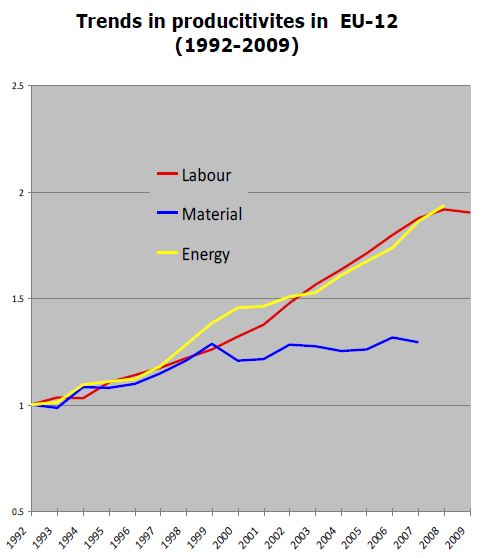
Europe imports 5 times more energy and resources than it exports, hence most of the trash that we bury or burn in Europe is not “ours”; is not always going to be there. In a world with finite resources and where emerging economies use more and more resources the Europeans will have to learn to make more with less if we want to keep our comfort standards. This is a radical change; what matters today is not labour productivity –as it has been since the industrial revolution- but the material productivity. Europe has to dramatically increase the efficiency with which it handles the resources and burning or burying them is not sensible.

See in the graph below -Eurostat data- the difference between the increase in labour productivity and material productivity in EU15.


For instance, one-way containers might make sense for the internal economics of some packaging companies but it is a very inefficient handling of materials which will be necessary in the future. Public authorities need to step in the markets to maximise the use of materials.

Zero Waste as a continued effort to prevent, reuse, recycle, and still look into residuals to see what can be done further is a good approach to measure material productivity; an economy that minimises the residual fraction of the waste is more energy and material efficient than an economy that generates waste -be it in the extraction, transport, manufacture and consumption phase-.
Why is it good to minimise the residual fraction

Besides the necessary increase of the material productivity for the future of the European economy there are other reasons to minimise the residual fraction.

When we talk about municipal waste the most expensive waste to treat once we consider the obligation of pretreatment, financial liability, reduced thresholds for emissions, etc  is the residual fraction (landfill and incineration), therefore if we reduce the amount of residual waste the costs for the municipality decrease which means that the citizen also saves money –less taxes-.

Also the treatments of residual waste are never clean; be it in a landfill where the waste will leach and pollute the soil and the water or in an incinerator where the waste will be turned into CO2, other organic and inorganic pollutants and toxic fly and bottom ashes that again need to be disposed of. In both cases there are health aspects related to the disposal of residual waste that have to be shouldered by the community and the citizens –hospitals, healthcare costs, losing of labour productivity…-.

Lastly, in order to minimise the residual part of the waste it is necessary to have regulation but also a good separate collection scheme that makes sure that no recyclables end up as residuals. This means more jobs for the community, jobs that cannot be delocalised and that bring in sustainability. Is this expensive? If we look at total costs the experience shows that it is cheaper to implement a separate collection scheme that minimises the residuals because the extra costs of separate collection are more than compensated with the reduction in the cost of residuals treatment –not to talk about hidden costs such as health, local employment…-.

Hence, also from a health and economic perspective it is always better to minimise the residual waste.
European examples of residual waste minimisation

The average waste generation in Europe is of half a ton per capita per year. Some countries generate 800kg/person and some others 350kg/person. The average recycling rate varies from country to country but if we look only to generation of residual waste –what cannot be reused or recycled- the average is around 300kg/person/year. An awful amount of waste!

Lawmakers and institutions should be looking at the amount of residual waste much more rather than focusing on separate collection and recycling only. This overcomes problems of systems where the emphasis on separate collection might produce high recycling rates but with a concurrent increase of waste arising. The parameter "minimisation of residual waste" rewards communities and programmes where separate collection is promoted in parallel with waste prevention.

In Europe there are already fantastic examples of minimisation of the residual fraction:
Flanders, Belgium

Flanders is the European champion in waste management not only because it recycles more than any other country in Europe (75%) but also because it focuses on minimising the residual waste. The average residual municipal solid waste in Flanders is around 150kg per person. 42 Flemish municipalities are below 100kg/person/year and there are two municipalities below 70Kg: Herenthout with 8.350hab generates only 59kg per person and Balen with 20.000hab 66Kg are the two leading municipalities.

But there are many others such as Aarschot (30.000hab and 84 kg) that are doing really well in their course towards sustainability.
Italy

In Italy thanks to the implementation of the door-to-door collection system 1500 municipalities are increasingly reducing their residual waste. For instance, the province of Treviso -with a population of 1 milion- generates an average of 85kg/person/year of residuals and there is a district around Udine that generates only 65kg/person.

In some small municipalities (some thousands of inhabitants) the results are extraordinary: Costigliole d’Asti thanks to achieving 82% of separate collection and the prevention policies the residual waste sent to disposal was of only 58kg/person/year. In Vilafranca d’Asti with 85% separate collection it was of 50kg/person, and in Castgnole delle Lanze with 84% separate collection they achieved the mark of 45kg/person/year!

The results of the door-to-door collection system are proving to be so successful that the region of Lazio (5,5 million inhabitants) has made it compulsory for all the municipalities.
Basque Country and Catalonia in Spain

In Spain the door-to-door collection has been implemented in more than 300 municipalities in Catalonia, Mallorca and the Basque Country and they have not only managed to increase the collection of recyclables –all above 60%- but also they have managed to reduce the generation of residual waste.

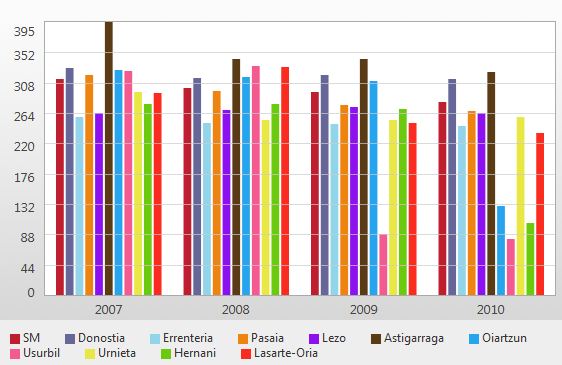
For instance in the Basque Country, the municipalities of Usurbil, Oiartzun and Hernani in one year managed to divide by four their generation of residuals thanks to the door-to-door separate collection (see graph). Currently Usurbil is at 80kg/person and Hernani and Oiartzun are approaching 100kg.

---
The economics, the physics and the common-sense show that it is necessary to move towards Zero Waste – reducing the residual part of our waste to the minimum is vital to plan a future without landfill and incineration.
READ MORE - Zero Waste is about minimising the residual waste

Senin, 22 November 2010

Zero Food Waste

"Taste the Waste" - the trailer from tastethewaste.com on Vimeo.

<iframe src="http://player.vimeo.com/video/15693148" width="400" height="225" frameborder="0"></iframe><p><a href="http://vimeo.com/15693148">"Taste the Waste" - the trailer</a> from <a href="http://vimeo.com/tastethewaste">tastethewaste.com</a> on <a href="http://vimeo.com">Vimeo</a>.</p>
READ MORE - Zero Food Waste

Jumat, 19 November 2010

Zero Waste - when recycling is not enough

Recycling an aluminium can requires 5% of the energy & material flow than what is necessary to produce a can from virgin materials. Recycling is great! It keeps materials in use, reducing the demand for extracting and producing new materials and delaying the time before the materials become waste. Therefore it is and should be encouraged and supported… but unfortunately it is far from enough to achieve sustainability.
Sustainability is about using current resources in a way that we can pass them on to the future generations; it is about preserving the ecological capital.

According to Eurostat 75% of Europeans think that separating the waste at home is their biggest contribution to fight climate change . It is true that with source separation it is possible to increase recycling rates. However, the real recycling –turning a bottle into a new bottle-happens very rarely. In most cases the materials are down-cycled because the new material has lost purity in comparison with the old product. Plus, recycling is often quite a dirty process.

More recycling doesn’t always mean more sustainability or less emissions. In Europe we see a certain confusion among policy makers and even among the –sometimes- self-appointed green cities or communities because they recycle 50 or 60% of their waste. This is missleading. For instance, according to Eurostat Denmark recycles 41% whilst Czech Republic recycled 3% of their municipal waste. At first sight one would think that Denmark is a lot more sustainable than the Czech Republic because they recycle more. However, if we look at the absolute numbers of waste we realise that with their high recycling rates Denmark still has a residual waste fraction that amounted to 472kg/capita/year (59% of the 801kg of total anual waste that they generate) whilst Czech Republic generated only 285kg/capita/year (97% of 294kg of total waste per capita). This means that in terms of material and energy flows the Czech Republic is more sustainable than Denmark. Therefore, sustainability is not a matter of –only- recycling more but rather of generating less waste.

Europe has to move from Recycling to Sustainability


Europe has to become a Sustainable Society rather than a Recycling Society, the latter is part of the former but as far as waste is concerned, waste reduction combined with increase in material productivity are of even more importance than recycling.

Zero waste is not only about closing the loop but also about making the loop smaller. The European Union aims to decouple waste generation from economic growth but this won’t be enough. It is necessary to reduce resource consumption regardless of the economic growth. Learn to do more with less. Indeed, if the world population continues to increase, with constant consumption patterns, at a higher rate than the rate we reduce waste the unsustainability is growing and not decreasing.

Recycling is mostly good and desirable but it can’t be the reason for complacency. It is precisely for these reasons that the new approaches to resource productivity go beyond recycling to approach sustainability taking into account more indicators:
- The leading region for recycling in Europe, Flanders, has adopted a Sustainable Material Management (SMM) strategy which looks at the whole material chain in order to better phase out waste by incorporating material design and productivity approach as part of waste prevention.
Simultaneously, the Environmental Directorate of the OECD is developing guidelines for SMM that are likely to be adopted by many OECD countries in order to effectively tackle the sustainability of the materials.
- In the Netherlands there has been the Chain Approach initiative in which the authorities partner with companies in order to reduce the waste at the end of the process.

Beyond recycling!


Landfill and incineration, together with other disposal options have no place in a sustainable Zero Waste society. Recycling is here to stay but its limitations start to show themselves in those places where recycling rates are above 50%; they have realised that recycling alone can’t do the work. They need to work in waste prevention, minimisation, raise awareness, product design, proper treatment, extended producer responsibility, etc in order to reduce its material and energy consumption without reducing its living standards.

The approach might be new but what we are doing in fact is go back to some traditional usages; designing things to last (from fashion as well as from product point of view), easy to be repaired or refurbished, with non-toxic materials, easy to dismantle or tear apart, traceable, recyclable, etc… Some companies have built a success out of these traditional principles. The English brand Vitsoe has been selling solid, long-lasting and design furniture since decades and has proven that is possible to live better with less that lasts longer. One of the mottos of Vitsoe is “we see recycling as a defeat”. Now it looks like, little by little, with the materials being more scarce and difficult to recover governments and organisations are also starting to look beyond recycling.

Zero Waste is a strategy aiming at doing more with less by improving the resource productivity in order to phase out the clearest symbol of inefficiency: waste!
READ MORE - Zero Waste - when recycling is not enough

Rabu, 10 November 2010

The Story of Electronics

Tired of electronic devices that break some months after having bought them? This short film from Annie Leonard explains very well the problem with designing for the dump.

The current design of electronic appliances that are hard to upgrade, easy to break and unpractical to repair to the extend that it is cheaper to buy a new product than to repair it shows that there is something wrong in the process.

Zero Waste is about good design that maximises durability, reusability, repairability and recyclability of the products.

READ MORE - The Story of Electronics

Selasa, 26 Oktober 2010

Zero junk mail in Europe!

The best waste is the waste that doesn’t exist. Prevention of unsolicited mail is one of many ways to prevent waste and many European countries have local prevention measures in place to stop unsolicited mail.

Sometimes placing a “STOP unsolicited mail” sticker on your mailbox it is enough to save moving 40kg of paper per year. Every kg of paper we discard means another kg of wood or recycled paper, 10 liters of water and 5Kwh of electricity with all its equivalent cost in €.

We tend to think that this junk mail we find in our mail-boxes is for free and that’s why some people don’t care. But this is false. The cost of this junk mail, like the cost of any marketing, can be found in the price of the products that is then charged to the consumer. Plus we have to pay for the treatment and disposal of the junk-mail because the producers are not responsible for it.

Prevention –first priority of the European waste hierarchy- is made of a number of small actions that will help reduce our waste generation to zero. Stopping junk mail is one of them.

In Europe there are no municipal, regional, national or European laws stopping junk mail. There are initiatives to protect privacy but none to stop unsolicited mail. Therefore it is up to the individual to stop junk mail.

If all Europe would stop unsolicited mail the EU would save 1 bilion € only in collection and treatment costs and 10 million tones of paper to the environment!

FRANCE


Putting a “STOP unsolicited mail” sticker on your mailbox in France


- saves an average of 40kg of paper per capita per year which means saving 20 to 40kg of wood, from 200 to 600kg of water, between 120 and 240 Kwh of electricity, ink with heavy metals plus additivies and colorants,

- has a cost of around 60€ -excluding distribution- that is charged to the consummers when they buy their products. Once the mail –consumed or non-consumed- is disposed of we need to add around 4€ per person to recycle or burn the paper that is again charged to the consumers.

To sum up, for a town of 60 000 inhabitants, the non-desired post represents 1200 tones/year and an expedinture of 120.000€ per year in collection and treatment costs. All this to manage something that nobody asked for...

If only 5% of the french use the “stop the pub” sticker the reduction of waste will be of 40.000 tones of paper!

UNITED KINGDOM

This is the situation in the UK:

- 17.5 billion pieces of junk mail are produced every year in the UK. This includes both addressed and unaddressed junk mail.

- To produce all this junk mail 550,000 tonnes of paper and 16.5 billion litres of water are used.

- Over the last five years the overall volume of junk mail sent out has decreased slightly, by an estimated 0.2 per cent per year.

- 650 pieces of junk mail are posted through the average British letterbox every year.

- On average 80 pieces of addressed junk mail are sent out to the 583,000 people who die every year in the UK following their death.

- 15 per cent of British households are registered with the Mailing Preference Service. Less than 0.5 per cent has opted out of receiving unaddressed junk mail delivered by Royal Mail.

-The most common source for the creation of junk mail lists is the edited electoral register. Yet, only 40 per cent of voters have opted out of being on this version of the electoral roll.

BELGIUM

In Belgium, Bruxelles Environement offers the possibility to stop the unsolicited email; anyone who desires to stop junk mail can call or send an email to Bruxelles-Environement and they send a sticker for free. This simple gesture saves time, it helps us focus on the important mail, it saves us money and it saves us moving papers up and down.

There is a lot of room for improvement, stop your unsolicited mail now!

References:
Diary of a junk mail campaigner
Stop PUB Campaign in France
Stop junk mail campaign in the UK
Stop the pub from Bruxelles-Environnement in Brussels

READ MORE - Zero junk mail in Europe!

Jumat, 15 Oktober 2010

Florianopolis is hosting the 7th International Conference Zero waste

Florianopolis, October 14, 2010 - The state capital of Santa Catarina was the Brazilian city chosen to host the 7th International Conference on Zero Waste, Zero Waste by the Institute in partnership with Brazil's Zero Waste International Alliance and Environmental Novociclo. On 28 and 29 October, Thursday and Friday, Florianópolis discuss the "Zero Waste Solutions for managing discarded resources, eliminating waste and pollution, creating new jobs, sustainablity and self reliance.

There are international experts, representatives of the private sector, academia, NGOs and politicians from federal, state and local sustainability programs that will discuss and present case studies of policies and projects, as well as actions that have worked in national and international scene. All events will be held at the Multipurpose Center Hotel Cacupé SESC.

Speakers include the Chair of the Zero Waste International Alliance , Richard V. Anthony and representatives from Zero Waste United Kingdom, Zero Waste South Africa, Zero Waste Italy, Zero Waste Canada, Zero Waste Philippines and a delegation from Zero Waste California as well as local experts.

Entries can be made through the site until October 25. The conference is targeted at students, researchers and professionals in Brazil and abroad in areas of design, architecture, urbanism, landscape architecture, biology, sociology, environment, education, public administration and engineering and representatives of civil society organizations that have a relationship directly or indirectly with urban planning, design, construction, management of a sustainable built environments, urban or rural.

Office Communications 7 th Conference internacionl zero waste
Juliana Guimarães
(48) 91210972
Service:
7th International Conference Zero Waste 28 and 29 October - Thursday and Friday
Multipurpose Center Hotel SESC Cacupé Florianópolis – SC
Registration and information:
www.conferencialixozero.com.br
or 55 (48) 3025-1134

Press information:

Gustavo Abdalla- (48) 3025 5899

Join the conference on facebook and twitter:

http://www.facebook.com/home.php?#!/novociclo?ref=search

http://www.twitter.com/@lixo_zero
READ MORE - Florianopolis is hosting the 7th International Conference Zero waste

Kamis, 30 September 2010

Example of a Zero Waste company - Interface

Ray Anderson, CEO of the biggest carpet producing company in the world Interface, explains how shifiting a billion-dollar petroleum-based industry into sustainability is not only possible but it is economically and morally rewarding.  Since the adoption of its zero-impact goals in 1995 the firm's use of fossil fuels and water, its greenhouse emissions and waste generation has fallen dramatically, while sales have increased by 2/3 and profits have doubled. Interface has diverted 74000tons of used carpets from landfills, while 1/4 of its materials are renewable and recycled.

The 400$ million Interface saved in costs avoided through the pursuit of Zero Waste has paid for all the costs of transforming its practices and facilities.

As he says in this video the Interface example: "dispels de myth of the false choice between the enfironment and the economy... if we, a petro-intensive company, can do it, anybody can. And if anybody can, it follows that everybody can".

READ MORE - Example of a Zero Waste company - Interface