Tampilkan postingan dengan label Separate Collection. Tampilkan semua postingan

Rabu, 04 April 2012

Castelbuono – the town where even donkeys’ walk the Zero Waste path

Creativity is at the core of a Zero Waste strategy. Sometimes this implies creating new processes and using innovative technologies but some other times it just requires combining the existing tools to create a low-tech win-win situation to reduce waste, create occupation, save money and increase sustainability. The example of Castelbuono is a good prove of this.

Castelbuono is a Zero Waste town of 10.000hab in Sicily, Italy, which has managed to develop an innovative system to marry sustainability, social work and economics. The mayor, Mario Cicero, decided to link the recovery of a traditional donkey-breed from Sicily –called Ragusa- with the challenges of the waste collection in narrow streets and the social work to reintegrate people into society... and all of this without scaring off the big number of tourists that visit the fantastic medieval castle or buy local products of this Sicilian town.

This is how Mr Cicero decided to use the donkeys to do the door-to-door separate collection. On one hand it makes donkeys useful so that recovering this breed stops being a cost to become an asset, on the other hand it becomes a way to reintroduce socially excluded people -with mental or addiction problems- thanks to using contact with animals as a therapy –onotherapy- and finally it turns waste collection into a tourist attraction and an education tool. A win-win situation!

Economics for donkeys

Mr Cicero explains how buying a small truck to collect waste costs more than 15,000eur and lasts 5 to 10 years whereas a donkey costs less than one tenth and last longer. Plus the maintenance costs of donkeys are a lot lower and they don’t need oil or electricity to run which makes them more cost efficient in a world of ever rising oil prices.

Besides, donkeys can be useful when they are not working collecting waste; on one hand their milk is considered to be the closest to human milk and hence very much valued. On the other hand onotherapy –therapy with donkeys- is proving wonders on mentally disabled people. Finally from the cultural point of view it makes cost-neutral recovering this important element of Sicilian and Mediterranean culture which is now once again participating in ceremonies and other local festivities.

It is difficult to make a cost-benefit analysis of this practice because it overarches on different fields but the fact is that;

-          money-wise the municipality has balanced accounts in waste collection and treatment,

-          the municipality has less expenses in subsidies to socially excluded people and has very high rates of integration to society,

-          the municipality is recovering an important part of its culture and even creating a tourist attraction at zero cost.

As a comparison; since 2008 –when the system was introduced in Castelbuono- the neighbouring municipality of CefalĂș, which is following the “modern” system of waste collection with road-containers and trucks, has generated millions of euros in debts to the regional public waste company whereas Castelbuono is one of the few municipalities in the region with balanced accounts.

Moreover, the region of Sicily has spent 1,5 million euros to reintroduce the Ragusa donkey but is not doing anything with them –it is a net cost-; instead Castelbuono started with 4 and now has 45 of these donkeys which are self-financing themselves.

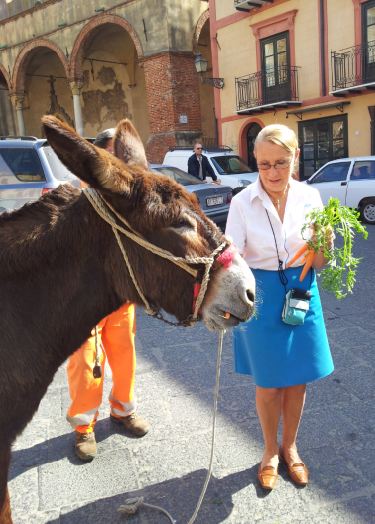
But even when they are collecting waste donkeys work wonders; tourists in Castelbuono appreciate this silent and gentle creatures and stop to play with them.
The personal story – donkeys help communities

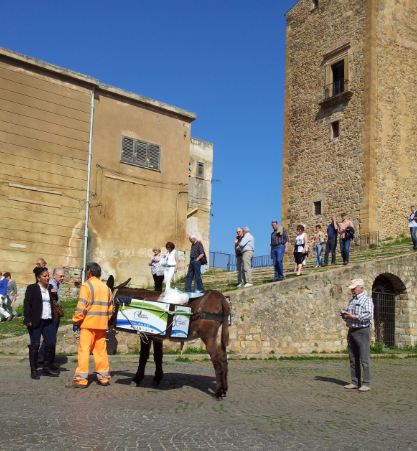
It is impressive to observe how neighbours in Castelbuono know the donkeys by the name and many stop to feed them when they pass by. When we visited them we accompanied one of the workers who does the tour with the donkey “Valentina”. Having had problems with depression & addiction in the past, before the introduction of donkeys he will not show up for work 5 days in a row. Since he started working with Valentina in 2008 he has not missed a single day of work and he has managed to reorganise his life. The bind between him and the animal and the daily contact with neighbours and tourists has managed to bring him back to society.


This personal story is just the top of the iceberg of a successful story of integration, education, creativity and sustainability in Castelbuono. Separate waste collection rates in this municipality are higher than in any of the neighbouring towns, they host a composting plant that treats the separately collected organics of the province and they are a proud member of the Italian network of Zero Waste municipalities. Many other ZW municipalities with similar characteristics inside and outside Sicily are studying importing this successful ZW practice.

 
READ MORE - Castelbuono – the town where even donkeys’ walk the Zero Waste path

Kamis, 29 September 2011

Mechanical Biological Treatment (MBT) & Zero Waste

Many cities have built Mechanical Biological Treatment Facilities (MBT) during the last decade with the aim of reducing the waste to be finally dumped or burnt. The results depend on every case but it is clear that MBT alone is not the sollution for anything. However it can play a role in transitional strategies to reduce residual waste without having to depend on more expensive undesirable options such as incineration. A well-designed ideal Zero Waste strategy shouldn’t need MBT.

What are MBTs?


MBT covers a wide range of activities and technologies to deal with residual waste –i.e. waste that hasn’t been separated for recycling or composting-. As the name explains it is composed of a mechanical part -in which waste is mechanically separated to recover recyclables- and a biological part –to either compost or digest the organic fraction-.

There are three main outputs from an MBT plant are; recyclables –such as PET plastic that can be sent for recycling-, low quality soil –the biologically stabilised part is used for land reclamation, almost never for agriculture- and RDF, Refuse Derived Fuel, which is a mix of materials with a homogeneus calorific value to burn in incinerators or in some cement kilns.

MBT became popular with the entry into force of the Landfill Directive which obliged member states to reduce the biodegradable waste going to landfill. MBT has the capacity to reduce the volume and methane emissions from waste, plus since it is modular it allows some flexibility and is cheaper and faster to build than any other big scale centralised options.

The draw-backs of MBT are that the bad quality of the compost they produce; almost always too polluted to be applied as soil improver. As a consequence, some authorities see MBT as a way to meet recycling rates without actually recycling and the production of RDF aimed at being burnt in incinerators and cement kilns.

MBT in Europe


MBT have been used with different success in Europe. For instance, in Germany they have been in use for more than 10 years and albeit having obtained some good results, the bigger the plant the more malodours and bacteria for the neighbourhood. The experience has been proven that MBT is not necessary when biowaste collection works well and there is high quality separate collection of other waste-streams combined with a good product policy promoting prevention of chlorine/PVC, heavy metals and flame retardants.

In Barcelona, Spain, MBT facilities were called ecoparcs and have been in operation since 10 years. Although they have managed to considerably reduce the amount of waste sent to landfills and are recovering materials for recycling it is a fact that no good compost has come out of these facilities whilst their production of RDF has increased. In fact, after all the expensive investments in MBT the city of Barcelona ended up implementing separate collection of organics (2010) after realising that the only way to get good compost is with input coming from biowaste source separation.

MBT and Zero Waste


A Zero Waste strategy means that waste should be prevented and source separation should be maximised. If all the products in the market would be recyclable and properly separately collected there will be no waste and hence no need for MBT. If MBT has a place in a Zero Waste strategy is only when dealing with the current 20-30% of total municipal solid waste that can’t be source separated and collected. In these cases MBT can be a temporary solution but always keeping in mind the goal of continuing minimising the residual waste.

In fact, the real name for MBT in a Zero Waste strategy would be a combination of a Material Recovery Center together with a Zero Waste Research Center. In these facilties the recoverable materials are recovered and the few residuals left are stabilised so that they can be safely landfilled after they go through the Zero Waste Research Center which analyses the defects in design in order to work upstream to make them recyclable in the future.

One of the pillars of Zero Waste is source separation of organics –the only way to obtain clean high-quality compost- and experience proves that this can’t be replaced by MBT.

Unfortunately there is no European legislation asking for separate collection of organics and hence European waste policy continues to lack a driver that would probably make MBT unnecessary. However, a growing number of Zero Waste municipalities are separately collecting biowaste and other waste fractions and already achieve high recovery rates combined with job creation.

The more separation at source the less separation is needed at the end (MBT) and the less disposal facilities (landfills and incinerators) are needed!
READ MORE - Mechanical Biological Treatment (MBT) & Zero Waste

Selasa, 30 November 2010

Zero Waste is about minimising the residual waste

http://www.seppo.net/e/In the last post we have explained why a society that manages to recycle 100% of its waste would not necessarily be sustainable. Our goal should be not only to recycle more, but to waste less.

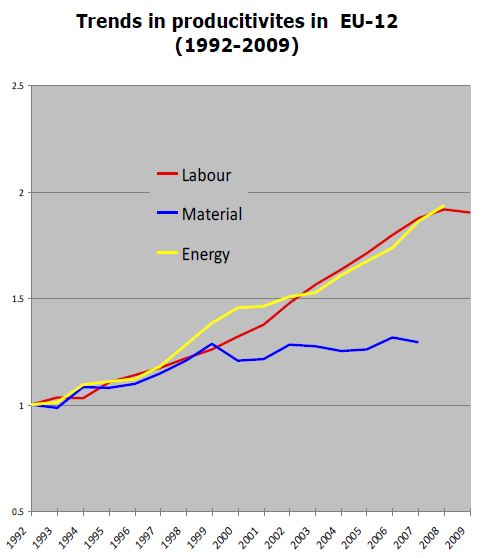
Europe imports 5 times more energy and resources than it exports, hence most of the trash that we bury or burn in Europe is not “ours”; is not always going to be there. In a world with finite resources and where emerging economies use more and more resources the Europeans will have to learn to make more with less if we want to keep our comfort standards. This is a radical change; what matters today is not labour productivity –as it has been since the industrial revolution- but the material productivity. Europe has to dramatically increase the efficiency with which it handles the resources and burning or burying them is not sensible.

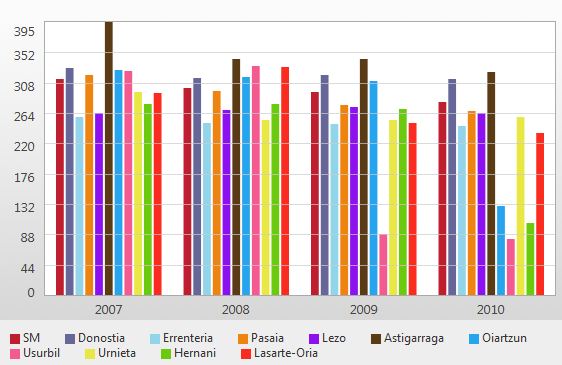
See in the graph below -Eurostat data- the difference between the increase in labour productivity and material productivity in EU15.


For instance, one-way containers might make sense for the internal economics of some packaging companies but it is a very inefficient handling of materials which will be necessary in the future. Public authorities need to step in the markets to maximise the use of materials.

Zero Waste as a continued effort to prevent, reuse, recycle, and still look into residuals to see what can be done further is a good approach to measure material productivity; an economy that minimises the residual fraction of the waste is more energy and material efficient than an economy that generates waste -be it in the extraction, transport, manufacture and consumption phase-.
Why is it good to minimise the residual fraction

Besides the necessary increase of the material productivity for the future of the European economy there are other reasons to minimise the residual fraction.

When we talk about municipal waste the most expensive waste to treat once we consider the obligation of pretreatment, financial liability, reduced thresholds for emissions, etc  is the residual fraction (landfill and incineration), therefore if we reduce the amount of residual waste the costs for the municipality decrease which means that the citizen also saves money –less taxes-.

Also the treatments of residual waste are never clean; be it in a landfill where the waste will leach and pollute the soil and the water or in an incinerator where the waste will be turned into CO2, other organic and inorganic pollutants and toxic fly and bottom ashes that again need to be disposed of. In both cases there are health aspects related to the disposal of residual waste that have to be shouldered by the community and the citizens –hospitals, healthcare costs, losing of labour productivity…-.

Lastly, in order to minimise the residual part of the waste it is necessary to have regulation but also a good separate collection scheme that makes sure that no recyclables end up as residuals. This means more jobs for the community, jobs that cannot be delocalised and that bring in sustainability. Is this expensive? If we look at total costs the experience shows that it is cheaper to implement a separate collection scheme that minimises the residuals because the extra costs of separate collection are more than compensated with the reduction in the cost of residuals treatment –not to talk about hidden costs such as health, local employment…-.

Hence, also from a health and economic perspective it is always better to minimise the residual waste.
European examples of residual waste minimisation

The average waste generation in Europe is of half a ton per capita per year. Some countries generate 800kg/person and some others 350kg/person. The average recycling rate varies from country to country but if we look only to generation of residual waste –what cannot be reused or recycled- the average is around 300kg/person/year. An awful amount of waste!

Lawmakers and institutions should be looking at the amount of residual waste much more rather than focusing on separate collection and recycling only. This overcomes problems of systems where the emphasis on separate collection might produce high recycling rates but with a concurrent increase of waste arising. The parameter "minimisation of residual waste" rewards communities and programmes where separate collection is promoted in parallel with waste prevention.

In Europe there are already fantastic examples of minimisation of the residual fraction:
Flanders, Belgium

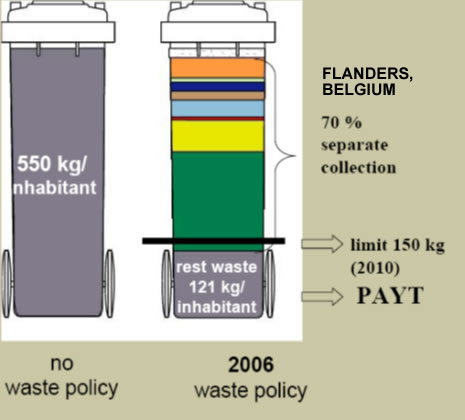
Flanders is the European champion in waste management not only because it recycles more than any other country in Europe (75%) but also because it focuses on minimising the residual waste. The average residual municipal solid waste in Flanders is around 150kg per person. 42 Flemish municipalities are below 100kg/person/year and there are two municipalities below 70Kg: Herenthout with 8.350hab generates only 59kg per person and Balen with 20.000hab 66Kg are the two leading municipalities.

But there are many others such as Aarschot (30.000hab and 84 kg) that are doing really well in their course towards sustainability.
Italy

In Italy thanks to the implementation of the door-to-door collection system 1500 municipalities are increasingly reducing their residual waste. For instance, the province of Treviso -with a population of 1 milion- generates an average of 85kg/person/year of residuals and there is a district around Udine that generates only 65kg/person.

In some small municipalities (some thousands of inhabitants) the results are extraordinary: Costigliole d’Asti thanks to achieving 82% of separate collection and the prevention policies the residual waste sent to disposal was of only 58kg/person/year. In Vilafranca d’Asti with 85% separate collection it was of 50kg/person, and in Castgnole delle Lanze with 84% separate collection they achieved the mark of 45kg/person/year!

The results of the door-to-door collection system are proving to be so successful that the region of Lazio (5,5 million inhabitants) has made it compulsory for all the municipalities.
Basque Country and Catalonia in Spain

In Spain the door-to-door collection has been implemented in more than 300 municipalities in Catalonia, Mallorca and the Basque Country and they have not only managed to increase the collection of recyclables –all above 60%- but also they have managed to reduce the generation of residual waste.

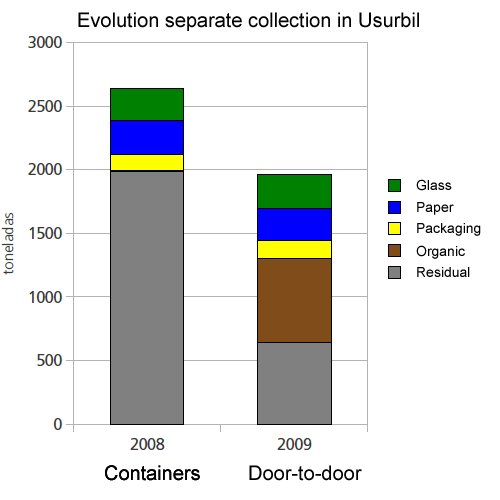
For instance in the Basque Country, the municipalities of Usurbil, Oiartzun and Hernani in one year managed to divide by four their generation of residuals thanks to the door-to-door separate collection (see graph). Currently Usurbil is at 80kg/person and Hernani and Oiartzun are approaching 100kg.

---
The economics, the physics and the common-sense show that it is necessary to move towards Zero Waste – reducing the residual part of our waste to the minimum is vital to plan a future without landfill and incineration.
READ MORE - Zero Waste is about minimising the residual waste

Kamis, 16 September 2010

Zero Waste and separate collection

No Zero Waste policy is possible without waste separation.
Waste doesn’t exist “per-se”, we create it when mixing our discards. If our discards are separated they are not waste but a resource. This is why the second step in waste management (after having done everything possible to prevent waste) is waste separation.

Waste can be separated at source –i.e. the citizen sorts out the waste- or at the end –i.e. a waste company separates the waste after it has been mixed-. When comparing both options source-separated systems not only significantly out-perform commingled collections on both material quality and diversion rate but also cost less.
For example, in order to re-melt glass into new containers, a high level of purity and colour sorting are required. Mixed or crushed glass is of no use for re-melting and is usually sold much cheaper for use as aggregate, which has no climate benefit. There is a big environmental benefit to recycling glass - each tonne of glass re-melted in the UK saves 314kg CO2 - so if possible glass should be separated by colour as it is collected. This is why the new Waste Framework Directive of the European Union requires source-separated collection except when it can be proved that it is not “technically, environmentally and economically practicable”(art.11).

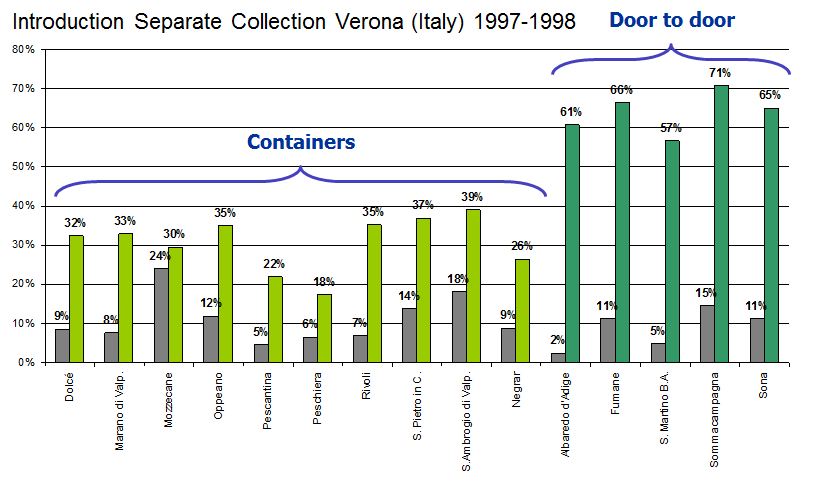
But when it comes to source-separate collection there are ways to optimise the process and achieve the highest diversion rates together with the highest purity of materials. In this sense, door-to-door separate collection provides a lot higher results than separate collection in containers. The European best practices in waste management use door-to-door collection.


FLANDERS, BELGIUM

Flanders in Belgium is the region with highest separate collection and recycling rates in Europe. Most of the collection takes place door-to-door and in some districts using the Pay-as-you-Throw (PAYT) system in which citizens pay according to how much residual waste they produce.

Right now Flanders separately collects 75% of their waste and some municipalities are above 80% recycling.

ITALY

In Italy more than 1500 municipalities have adopted “door-to-door” separate collection and are already above 55% source separation. 20% of them (300 municipalities) are over 80% source separation.

Door-to-door collection takes place in all kinds of communities; the whole of Torino province (2,5 million hab.) has achieved rates above 50% separate collection. Downtown Torino in only 3 years since the start of door-to-door they have jumped from 25% to almost 60% separate collection. Other cities such as Trento (110.000hab) or Novara (100.000hab) have achieved impressive separate collection rates and even Milan is starting to use door-to-door collection.

All italian Zero Waste municipalities are using door-to-door separate collection. The first Zero Waste municipality in Italy, Capannori (50.000 hab) jumped from a separate collection of 37% in 2005 to 82% in 2008 thanks to the introduction of door-to-door separate collection.

Economic impact: The cost of moving into door-to-door system were entirely covered by the savings of recycling 16000tons of waste instead of sending it to disposal. In total a saving of 2.348.000 million € for 2007 which allowed to reduce the bill of the citizens by 20%.

Environmental impact: only looking at the effects of recycling the 6000 tones of paper and cardboard that was being burnt and now is recycled: it avoided logging 100.000 trees, the consumption of 2.85 millions of liters of water (enough to provide water to 31000hab) and the emission of 9.100 tones of CO2 (equal to the emissions of 680.000 oil barrels).

SPAIN

Following the Italian succesful initiative the first door-to-door separate collection in Spain took place in Catalonia where right now more than 100 municipalities use the door-to door system.

The system is also starting to be used elsewhere in the country, more concretely in Mallorca (30 municipalities) and the Basque Country: In the Basque Country Usurbil was the first Zero Waste municipality in the Basque Country and hence the first one to adopt door-to-door collection in 2009 and in 7 months managed to jump from 28% to 82% of separate collection and achieved 36% of waste reduction. The success has encouraged other municipalities (Hernani and Oiartzun) to join the Zero Waste strategy and source-separate waste and they are both currently recycling more than 80% of their waste whilst reducing their waste generation with measures such as home composting.
Right now in Spain the percentages of separate collection for those municipalities with door-to-door collection almost triple those with containers.

Door-to-door separate collection is not exclusive for Europe; it is happening also overseas and the Zero Waste city of San Francisco in the US is the leading city in recycling the american continent and recycles already 75% of the waste.

The Zero Waste practices from around the world prove the convenience -in environmental and social terms- and cost-efficiency of door-to-door separate collection.
READ MORE - Zero Waste and separate collection