Tampilkan postingan dengan label Electronics. Tampilkan semua postingan

Rabu, 07 Desember 2011

Reuse of WEEE: widening the cycle of materials

Giving a second life to products before they are –hopefully- dismantled for safe recycling is the most preferable option. Yet “some” say the demand for second-hand electric and electronic goods is low and it is better to send them to dismantle and get yourself a new one. Think twice! The opposite is true.


In many cases those who argue against reusing electric and electronic goods are the same companies that produce them and therefore have an interest in you buying a new a new one. But some other times it is true that some people just don’t want a second hand electronic appliance. What is for sure is that today there are plenty of electric and electronic goods which are discarded despite being still fully operative or easily reusable if fixed.


New data from recent studies on reuse in the EU indicate that:

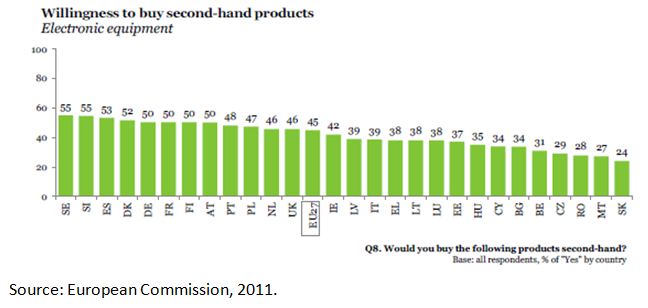
 There is strong market demand across Europe for quality second hand electronic goods. On average, 50% of people in Europe –according to a survey by Flash Eurobarometer- would be happy to buy a second hand appliance.
WEEE reuse is a significant employer opportunity particularly if carried out by social enterprises and has potential to employ 10 times more people per tonne of material processed than recycling activities.
Lack of appropriate legislation is seen as one of the main barriers to WEEE reuse activities on the ground,

Indeed, the waste hierarchy as approved in the current European legislation establishes the clear priority of preparation for reuse before recycling and disposal but unfortunately there are no targets or incentives to make this happen yet.


However in October 2011 the Environment Committee in the European Parliament voted in favour of a 5% target for reuse in the collection targets, a requirement for producers to provide information free of charge about preparation for reuse and treatment of the appliances they out in the market, requiring all collection schemes to provide for the separation of reusable WEEE at collection points and the adoption of European standards for preparation for reuse (to be created in max 3 years).


This positive outcome still needs to be approved by the EU member states before it can enter into force. So far the member state have been very reluctant to these measures and if no agreement is reached during this month of December the negotiations will have to go to conciliation which would downsize the ambition of the targets.

Given the increasing prices of raw materials, the employment opportunities linked to the reuse sector and the high energy embodied in these products it is necessary to improve collection and reuse rates of goods to get closer to a Zero Waste economy.
READ MORE - Reuse of WEEE: widening the cycle of materials

Jumat, 11 Februari 2011

The need for Zero Electric and Electronic Waste in Europe

Can you believe that from all electric and electronic waste generated in Europe only 19% is recycled? Yes, in times where materials are more and more scarce and the prices continue to rise and when the EU is almost completely dependent on foreign supply for metals and rare earths we still afford to let 81% of these resources escape from being reintroduced in the production process in Europe.

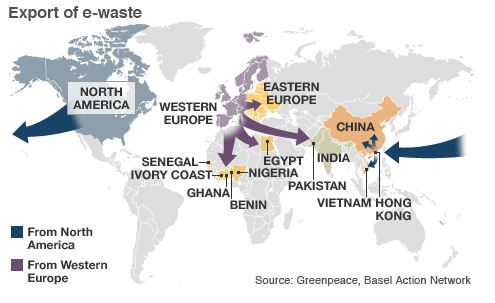
Today more than 50% of the WEEE generated in Europe follows unofficial collection routes, sometimes leading to illegal export and improper treatments. E-waste contains hazardous substances such as heavy metals and chemicals which can damage human health and the environment especially when treated incorrectly. Unfortunately there are plenty of well-documented examples of the environmental and health damage that this exported e-waste causes in Africa and Asia.

But also, if we let 81% of WEEE escape Europe this means that with it we let a big amount of manufacturing industry and jobs escape. This is like having a gold mine and letting others come and take the gold away –albeit paying a high price in health and environmental damage- whilst at the same time complain that the economic crisis is taking the jobs away. Action is needed to reverse these figures.

Action has to go inte direction of setting standards for WEEE recycling but also incentives to redesign them. An important reason why e-waste is not recycled is precisely because electric and electronic items are not well-designed. If designed differently it would be a lot easier and cheaper to manipulate WEEE to extract the raw materials.

This is why the EU is working on an update of the WEEE directive. On the 3rd of February the Environment Committee of the European Parliament voted in favour of an ambitious collection target based on WEEE generated, setting standards on e-waste management and enabling financial incentives for optimized design. The European Parliament requires member states to address financial resources to increase collection and also asks for a better consideration for nanomaterials in treatment processes.

The problem is that in the current economic crisis most EU member states only think on cutting expenditure and sometimes fail to see the hidden benefits of economy booster that can represent investing in capturing more WEEE. The economic booster works in several ways: it creates local jobs in collection and reprocessing, it saves costs in buying new raw materials and saves extraction, processing and transport emissions related to new production.

Sending Zero Electric and Electronic Waste to landfill and incineration just makes sense but turning this waste into resource is an indispensable part of the new industrial revolution. Maximising material productivity is the way forward and Zero Waste is a vital part of it.
READ MORE - The need for Zero Electric and Electronic Waste in Europe

Jumat, 10 Desember 2010

Zero Waste to reduce EU dependency on materials

The clever thing about minimising waste and recycling stuff is that we recover the materials and we can use them again instead of having to import them from far at increasing prices.


The resources in the world are not only limited; they are also becoming more and more scarce and hence more difficult, polluting and expensive to extract. In absolute terms, Europe is using more and more resources. For example, resource use increased by 34 % between 2000 and 2007 in the EU-12. This continues to have considerable environmental and economic consequences. Of 8.2 billion tonnes of materials used in the E-27 in 2007, minerals and including metals accounted for more than half, and fossil fuels and biomass for about a quarter each.
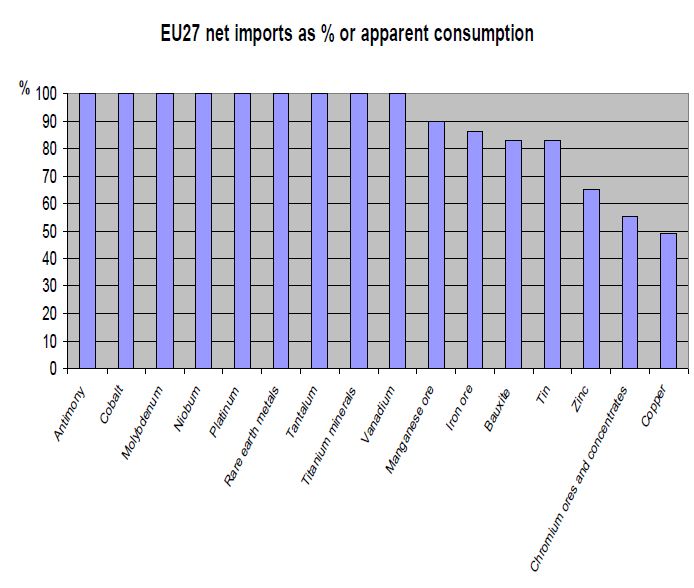
In the following graph we can see how heavily dependent is the EU from imports of metals (source EEA).


For the majority of metals the EU depends 100% on its imports. At the same time what we see is that in the EU 50% of the recyclable municipal waste is landfilled or incinerated and the exports –legal and ilegal- of metals and electronics to be recycled –mostly downcycled- have increased. From the strategic point of view –let alone environmental and economical considerations- this is nothing less than stupid.


The recycling sector in Europe has an estimated turnover of EUR 24 billion and employs about half a million persons. Thus, the EU has 50 % of the recycling industries in the world. Yet, the EU lets most of its electronic waste to be shipped abroad for low quality recycling when nobody in the earth needs more the resources than the EU.


The EU has been producing legislation to try to shift this exodus of materials into european recycling plants. So far the directive on waste from electric and electronic equipment has required that every member state collects 4kg per capita per year but right now there are countries like Belgium or Germany that are well above this target whilst others are far below. The revision of the WEEE aims to collect 65% of generated WEEE by 2016 which is a very necessary improvement to create jobs and a solid recycling industry in Europe that reduces necessity to extract, process, and transport the materials that we need.


Some companies are proving that, if they are given the chance, they can recover most of the materials and generate jobs and economic activity whilst avoiding the extra emissions of exporting waste for disposal and having to extract and manufacture new materials. Umicore, for instance, is one of the leading companies in Europe in recycling of WEEE and shows the changing trends; from being a belgian mining company with poor environmental record they understood that the future was to focus not on extracting materials from the earth but rather to extract them from the already produced equipments that had become waste. Thanks to this Umicore has not only managed to be a world leading recycler but it has also managed to pay its environmental liabilities.


Umicore treats 300.000 tones of electric and electronic waste from which only 15.000 tones become waste; that is 95% of the waste is recycled. Whilst there are some rare earths present in small devices such as mobile phones and which so far can’t be recovered the truth is that most metals are recovered at a higher rate than what can be achieved in backyard recycling –what would happen if exported outside Europe-. For instance, in Umicore 95 to 99% of gold is recovered whilst in backyard recycling only 20 to 25% can be recovered –with a lot higher enviornmental and health impact-.


It is therefore possible to close the loop in some sectors of our economy but in order to do so it is necessary that the authorities collaborate with the right legislation and market drivers. Highly efficient recycling systems keep jobs in Europe, reduce dependency from imports, lower emissions, reduce environmental impact in third countries and help move in the direction of sustainability if they are combined with the right prevention tools.


Zero Waste is about reducing the use of materials, reusing them as much as possible and recycling them as last option. Europe can’t afford to continue trashing resources; eliminating waste with incineration and landfill don’t make sense but this is even more true in the case of electric and electronic waste.


The clever thing about minimising waste and recycling stuff is that we recover the materials and we can use them again instead of having to import them from far at increasing prices.
The resources in the world are not only limited; they are also becoming more and more scarce and hence more difficult, polluting and expensive to extract. In absolute terms, Europe is using more and more resources. For example, resource use increased by 34 % between 2000 and 2007 in the EU-12. This continues to have considerable environmental and economic consequences. Of 8.2 billion tonnes of materials used in the E-27 in 2007, minerals and including metals accounted for more than half, and fossil fuels and biomass for about a quarter each.
In the following graph we can see how heavily dependent is the EU from imports of metals (source EEA).
READ MORE - Zero Waste to reduce EU dependency on materials

Rabu, 10 November 2010

The Story of Electronics

Tired of electronic devices that break some months after having bought them? This short film from Annie Leonard explains very well the problem with designing for the dump.

The current design of electronic appliances that are hard to upgrade, easy to break and unpractical to repair to the extend that it is cheaper to buy a new product than to repair it shows that there is something wrong in the process.

Zero Waste is about good design that maximises durability, reusability, repairability and recyclability of the products.

READ MORE - The Story of Electronics