Selasa, 28 Desember 2010

LAST MINUTE MARKET – a great tool of waste prevention

In the last post we dealt with the worrying amounts of food waste in Europe. In this post we want to present an european fantastic and succesful initiative to reduce the food waste; the Last Minute Market.

Last Minute Market (LMM) links shops and producers (processing industries, food shops, retail stores and the like) who have unsold food which would otherwise be discarded with people and charities who need food.
Prof. Andrea Segrè started with this project in 1998. The University of Bologna developped SMM as a spin-off and it is now active in more than 40 Italian towns and has new projects starting in other places in the world.

LMM operates in the areas of unsold but edible food, unharvested vegetables, non-conform seeds, un-used catering products, unsold books and now also unused pharmaceuticals.

LMM eliminates waste by helping companies manage surplus (food and other items) and taking them out of the disposal route. Public institutions and communities also benefit from the reduction in the flow of waste to landfill and incineration which saves them money in taxes, health and environmental damage and less dependency on further foreign food imports. Finally it also improves food availability for the sectors of society that need it, and third sector (charity) destinataries who reduce operating costs and release resources for other projects.

LMM brings about environmental, economic and social benefits. According to founder Prof. Segrè if LMM Food were to be adopted nationwide in Italy by supermarkets, small shops and cash and carry shops, €928,157,600 would be recuperated in products. Furthermore, these products could provide 3 meals a day to 636,000 people – in total 580,402,025 meals a year. Also by not sending these products to the landfill, 291,393 tonnes of CO2 emissions could be spared.

In April 2010 LMM launched “ancora utili”, a program to recuperate unexpired prescription drugs donated by single users, doctors or hospitals. The pilot project in Ferrara has involved 11 pharmacies is projected to collect drugs for a market value of 15,000 euros per year.

In October 2010 LMM was presented in the European Parliament and the Agriculture Committee approved this resolution to reduce 50% of the amount of food waste throughout the food chain.

LMM is a win-win project and another piece of a Zero Waste strategy. The prevention of waste helps optimise resource use with benefits for the different stakeholders as well as for the environment.

For further information (in italian) see www.lastminutemarket.org
READ MORE - LAST MINUTE MARKET – a great tool of waste prevention

Kamis, 23 Desember 2010

Towards Zero Food Waste in the EU

In Europe an estimated amount of 50% of the food produced is wasted. This changes from country to country and from sector to sector but in the best case not less than 20% of our food ends up as waste. At the same time more than 50 million of Europeans are at the risk of poverty. This is simply unacceptable from a social, economic and environmental point of view.

Unhealthy, uneconomic and unsustainable


In Sweden, an average household is estimated to throw away 25% of food purchased. An average Danish family with 2 adults and 2 children wastes food for 1.341 € a year (2.15 billion € for the whole country). In Italy, about 20.290.767 tonnes of food waste are formed every year along the whole supply chain. Each French citizen throws away every year 7 kilos of food still in the original package when in the same country, 8 million people are at risk of poverty.

Simultaneously, studies show that western countries are consuming every day a surplus of 1400 calories per person for a total of 150 trillion calories a year. So, apart from the waste in the food supply chain, overeating is gradually becoming a serious public health issue in a growing number of countries.

From the environmental perspective food waste accounts for more than one quarter of the total consumptive use of finite and vulnerable freshwater and more than 300 million barrels of oil per year. Moreover each tonne of food waste generates 4.2 tonnes of CO2.

How is food waste generated?


Among the many several reasons we find that packages are too large for small households, that the portions prepared for each meal tend to be too big, failed preparation of the recipe, incorrect transport, fear of deterioration caused by the proximity to the expire date, not wanting to eat leftovers from the previous day, bad refrigerator... Nothing that can’t be fixed.

Taking action for Zero Food Waste


Like with any other process human beings have to learn to manage this resource named food. In the past a lot less food was wasted; the wastage started 50 years ago with the over-abundance of products and very low cost of disposal; this caused that Europeans paid less attention to the food waste they generated.

Times have changed; overabundance times are over and the costs of this irresponsible and inefficient behaviour are increasing. The world population has grown tenfold and hunger is still persistent and growing –also in Europe-, the EU has constant and unsustainable yearly deficit of 75 million tons of biomass with the rest of the world, the costs of disposal for waste continue to increase and EU legislation pushes in prevention.
Much of the food wastage can be reduced with the right prevention policies and campaigns to make sure that what would otherwise be waste can be still eaten or reintroduced in the system. Measures as simple as changing the size of the portions, supplying food in smaller packages (beware of the packaging waste), training young people in how to preserve food, etc… are part of the tool-box we need to address the problem.

In this direction, it is to be welcomed that on the 28th October 2010 the agriculture committee of the European Parliament approved a joint declaration against food waste in which they were asking for a reduction of 50% of the amount of food waste throughout the food chain.

Unfortunately the Environment Directorate of the European Commission still hasn't considered appropiate to include neither waste prevention targets nor recycling targets for biowaste in EU legislation which is stopping the EU from making major shift forward in the reduction of food waste. In the future it will be necessary to work at European, national and local level in order to reduce this big sign of unsustainability and inefficiency that is food waste.

Below we can find some encouraging initiatives and campaigns in some EU member states:

United Kingdom Loves Food and Hates Waste


In Britain every year 18 million tonnes of food still perfectly edible are thrown away (WRAP) by households alone for an annual retail value cost of 14 billion pounds: at the same time 4 million people in the UK do not have access to a healthy diet. The environmental implications of stopping to produce food waste would have a CO2 equivalent of taking 1 in 4 cars off the road.

For this reason WRAP launched the campaign “Love Food - Hate Waste” in 2007 which by January 2009 was already a success in making 2 million UK households take steps to reduce food waste: this has stopped 137,000 tons of food from being thrown away which prevented 600,000 tonnes being emitted and resulted in a saving of nearly 300 million £ .

Visit their website for great tips about how to reduce your food waste: http://www.LoveFoodHateWaste.com

Holland tastes the food waste


The Netherlands is throwing away 2.4 billion € per year on food waste, that is more than 400€ per household representing more than 20% of the total food in the market.

For this reason the Dutch government has committed to reduce by at least 20% the food waste by 2015. To achieve this goal and following the example of the successful initiative in the UK the campaign “taste the waste” has been launched in which they teach how to save money without too much extra effort.
The Dutch campaign has also sparked the creation of a global campaign to fight food waste, that is www.tastethewaste.com

Sources:
French Environment and Energy Management Agency

Danish Agriculture & Food Council -2010
Lundqvist, J. 2010 ’Producing more or Wasting Less. Bracing the food security challenge of unpredictable rainfall’.
The Progressive Increase of Food Waste in America and Its Environmental Impact by Kevin D. Hall, Juen Guo, Michael Dore, Carson C. Chow
READ MORE - Towards Zero Food Waste in the EU

Jumat, 10 Desember 2010

Zero Waste to reduce EU dependency on materials

The clever thing about minimising waste and recycling stuff is that we recover the materials and we can use them again instead of having to import them from far at increasing prices.


The resources in the world are not only limited; they are also becoming more and more scarce and hence more difficult, polluting and expensive to extract. In absolute terms, Europe is using more and more resources. For example, resource use increased by 34 % between 2000 and 2007 in the EU-12. This continues to have considerable environmental and economic consequences. Of 8.2 billion tonnes of materials used in the E-27 in 2007, minerals and including metals accounted for more than half, and fossil fuels and biomass for about a quarter each.
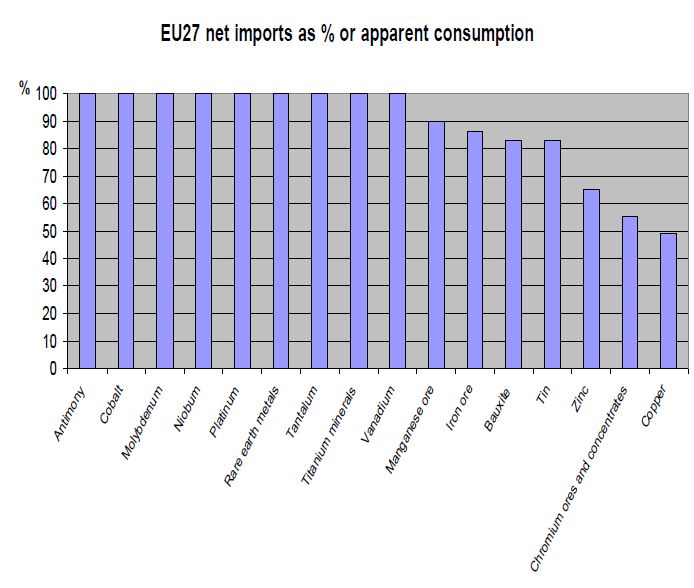
In the following graph we can see how heavily dependent is the EU from imports of metals (source EEA).


For the majority of metals the EU depends 100% on its imports. At the same time what we see is that in the EU 50% of the recyclable municipal waste is landfilled or incinerated and the exports –legal and ilegal- of metals and electronics to be recycled –mostly downcycled- have increased. From the strategic point of view –let alone environmental and economical considerations- this is nothing less than stupid.


The recycling sector in Europe has an estimated turnover of EUR 24 billion and employs about half a million persons. Thus, the EU has 50 % of the recycling industries in the world. Yet, the EU lets most of its electronic waste to be shipped abroad for low quality recycling when nobody in the earth needs more the resources than the EU.


The EU has been producing legislation to try to shift this exodus of materials into european recycling plants. So far the directive on waste from electric and electronic equipment has required that every member state collects 4kg per capita per year but right now there are countries like Belgium or Germany that are well above this target whilst others are far below. The revision of the WEEE aims to collect 65% of generated WEEE by 2016 which is a very necessary improvement to create jobs and a solid recycling industry in Europe that reduces necessity to extract, process, and transport the materials that we need.


Some companies are proving that, if they are given the chance, they can recover most of the materials and generate jobs and economic activity whilst avoiding the extra emissions of exporting waste for disposal and having to extract and manufacture new materials. Umicore, for instance, is one of the leading companies in Europe in recycling of WEEE and shows the changing trends; from being a belgian mining company with poor environmental record they understood that the future was to focus not on extracting materials from the earth but rather to extract them from the already produced equipments that had become waste. Thanks to this Umicore has not only managed to be a world leading recycler but it has also managed to pay its environmental liabilities.


Umicore treats 300.000 tones of electric and electronic waste from which only 15.000 tones become waste; that is 95% of the waste is recycled. Whilst there are some rare earths present in small devices such as mobile phones and which so far can’t be recovered the truth is that most metals are recovered at a higher rate than what can be achieved in backyard recycling –what would happen if exported outside Europe-. For instance, in Umicore 95 to 99% of gold is recovered whilst in backyard recycling only 20 to 25% can be recovered –with a lot higher enviornmental and health impact-.


It is therefore possible to close the loop in some sectors of our economy but in order to do so it is necessary that the authorities collaborate with the right legislation and market drivers. Highly efficient recycling systems keep jobs in Europe, reduce dependency from imports, lower emissions, reduce environmental impact in third countries and help move in the direction of sustainability if they are combined with the right prevention tools.


Zero Waste is about reducing the use of materials, reusing them as much as possible and recycling them as last option. Europe can’t afford to continue trashing resources; eliminating waste with incineration and landfill don’t make sense but this is even more true in the case of electric and electronic waste.


The clever thing about minimising waste and recycling stuff is that we recover the materials and we can use them again instead of having to import them from far at increasing prices.
The resources in the world are not only limited; they are also becoming more and more scarce and hence more difficult, polluting and expensive to extract. In absolute terms, Europe is using more and more resources. For example, resource use increased by 34 % between 2000 and 2007 in the EU-12. This continues to have considerable environmental and economic consequences. Of 8.2 billion tonnes of materials used in the E-27 in 2007, minerals and including metals accounted for more than half, and fossil fuels and biomass for about a quarter each.
In the following graph we can see how heavily dependent is the EU from imports of metals (source EEA).
READ MORE - Zero Waste to reduce EU dependency on materials

Selasa, 30 November 2010

Zero Waste is about minimising the residual waste

http://www.seppo.net/e/In the last post we have explained why a society that manages to recycle 100% of its waste would not necessarily be sustainable. Our goal should be not only to recycle more, but to waste less.

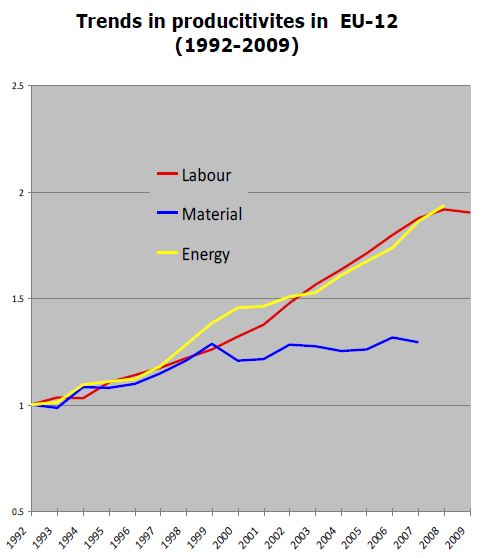
Europe imports 5 times more energy and resources than it exports, hence most of the trash that we bury or burn in Europe is not “ours”; is not always going to be there. In a world with finite resources and where emerging economies use more and more resources the Europeans will have to learn to make more with less if we want to keep our comfort standards. This is a radical change; what matters today is not labour productivity –as it has been since the industrial revolution- but the material productivity. Europe has to dramatically increase the efficiency with which it handles the resources and burning or burying them is not sensible.

See in the graph below -Eurostat data- the difference between the increase in labour productivity and material productivity in EU15.


For instance, one-way containers might make sense for the internal economics of some packaging companies but it is a very inefficient handling of materials which will be necessary in the future. Public authorities need to step in the markets to maximise the use of materials.

Zero Waste as a continued effort to prevent, reuse, recycle, and still look into residuals to see what can be done further is a good approach to measure material productivity; an economy that minimises the residual fraction of the waste is more energy and material efficient than an economy that generates waste -be it in the extraction, transport, manufacture and consumption phase-.
Why is it good to minimise the residual fraction

Besides the necessary increase of the material productivity for the future of the European economy there are other reasons to minimise the residual fraction.

When we talk about municipal waste the most expensive waste to treat once we consider the obligation of pretreatment, financial liability, reduced thresholds for emissions, etc  is the residual fraction (landfill and incineration), therefore if we reduce the amount of residual waste the costs for the municipality decrease which means that the citizen also saves money –less taxes-.

Also the treatments of residual waste are never clean; be it in a landfill where the waste will leach and pollute the soil and the water or in an incinerator where the waste will be turned into CO2, other organic and inorganic pollutants and toxic fly and bottom ashes that again need to be disposed of. In both cases there are health aspects related to the disposal of residual waste that have to be shouldered by the community and the citizens –hospitals, healthcare costs, losing of labour productivity…-.

Lastly, in order to minimise the residual part of the waste it is necessary to have regulation but also a good separate collection scheme that makes sure that no recyclables end up as residuals. This means more jobs for the community, jobs that cannot be delocalised and that bring in sustainability. Is this expensive? If we look at total costs the experience shows that it is cheaper to implement a separate collection scheme that minimises the residuals because the extra costs of separate collection are more than compensated with the reduction in the cost of residuals treatment –not to talk about hidden costs such as health, local employment…-.

Hence, also from a health and economic perspective it is always better to minimise the residual waste.
European examples of residual waste minimisation

The average waste generation in Europe is of half a ton per capita per year. Some countries generate 800kg/person and some others 350kg/person. The average recycling rate varies from country to country but if we look only to generation of residual waste –what cannot be reused or recycled- the average is around 300kg/person/year. An awful amount of waste!

Lawmakers and institutions should be looking at the amount of residual waste much more rather than focusing on separate collection and recycling only. This overcomes problems of systems where the emphasis on separate collection might produce high recycling rates but with a concurrent increase of waste arising. The parameter "minimisation of residual waste" rewards communities and programmes where separate collection is promoted in parallel with waste prevention.

In Europe there are already fantastic examples of minimisation of the residual fraction:
Flanders, Belgium

Flanders is the European champion in waste management not only because it recycles more than any other country in Europe (75%) but also because it focuses on minimising the residual waste. The average residual municipal solid waste in Flanders is around 150kg per person. 42 Flemish municipalities are below 100kg/person/year and there are two municipalities below 70Kg: Herenthout with 8.350hab generates only 59kg per person and Balen with 20.000hab 66Kg are the two leading municipalities.

But there are many others such as Aarschot (30.000hab and 84 kg) that are doing really well in their course towards sustainability.
Italy

In Italy thanks to the implementation of the door-to-door collection system 1500 municipalities are increasingly reducing their residual waste. For instance, the province of Treviso -with a population of 1 milion- generates an average of 85kg/person/year of residuals and there is a district around Udine that generates only 65kg/person.

In some small municipalities (some thousands of inhabitants) the results are extraordinary: Costigliole d’Asti thanks to achieving 82% of separate collection and the prevention policies the residual waste sent to disposal was of only 58kg/person/year. In Vilafranca d’Asti with 85% separate collection it was of 50kg/person, and in Castgnole delle Lanze with 84% separate collection they achieved the mark of 45kg/person/year!

The results of the door-to-door collection system are proving to be so successful that the region of Lazio (5,5 million inhabitants) has made it compulsory for all the municipalities.
Basque Country and Catalonia in Spain

In Spain the door-to-door collection has been implemented in more than 300 municipalities in Catalonia, Mallorca and the Basque Country and they have not only managed to increase the collection of recyclables –all above 60%- but also they have managed to reduce the generation of residual waste.

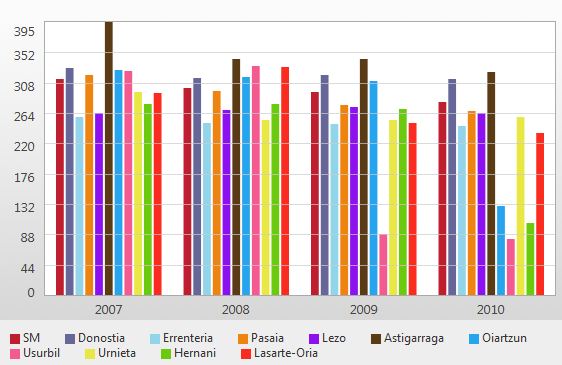
For instance in the Basque Country, the municipalities of Usurbil, Oiartzun and Hernani in one year managed to divide by four their generation of residuals thanks to the door-to-door separate collection (see graph). Currently Usurbil is at 80kg/person and Hernani and Oiartzun are approaching 100kg.

---
The economics, the physics and the common-sense show that it is necessary to move towards Zero Waste – reducing the residual part of our waste to the minimum is vital to plan a future without landfill and incineration.
READ MORE - Zero Waste is about minimising the residual waste

Senin, 22 November 2010

Zero Food Waste

"Taste the Waste" - the trailer from tastethewaste.com on Vimeo.

<iframe src="http://player.vimeo.com/video/15693148" width="400" height="225" frameborder="0"></iframe><p><a href="http://vimeo.com/15693148">"Taste the Waste" - the trailer</a> from <a href="http://vimeo.com/tastethewaste">tastethewaste.com</a> on <a href="http://vimeo.com">Vimeo</a>.</p>
READ MORE - Zero Food Waste

Jumat, 19 November 2010

Zero Waste - when recycling is not enough

Recycling an aluminium can requires 5% of the energy & material flow than what is necessary to produce a can from virgin materials. Recycling is great! It keeps materials in use, reducing the demand for extracting and producing new materials and delaying the time before the materials become waste. Therefore it is and should be encouraged and supported… but unfortunately it is far from enough to achieve sustainability.
Sustainability is about using current resources in a way that we can pass them on to the future generations; it is about preserving the ecological capital.

According to Eurostat 75% of Europeans think that separating the waste at home is their biggest contribution to fight climate change . It is true that with source separation it is possible to increase recycling rates. However, the real recycling –turning a bottle into a new bottle-happens very rarely. In most cases the materials are down-cycled because the new material has lost purity in comparison with the old product. Plus, recycling is often quite a dirty process.

More recycling doesn’t always mean more sustainability or less emissions. In Europe we see a certain confusion among policy makers and even among the –sometimes- self-appointed green cities or communities because they recycle 50 or 60% of their waste. This is missleading. For instance, according to Eurostat Denmark recycles 41% whilst Czech Republic recycled 3% of their municipal waste. At first sight one would think that Denmark is a lot more sustainable than the Czech Republic because they recycle more. However, if we look at the absolute numbers of waste we realise that with their high recycling rates Denmark still has a residual waste fraction that amounted to 472kg/capita/year (59% of the 801kg of total anual waste that they generate) whilst Czech Republic generated only 285kg/capita/year (97% of 294kg of total waste per capita). This means that in terms of material and energy flows the Czech Republic is more sustainable than Denmark. Therefore, sustainability is not a matter of –only- recycling more but rather of generating less waste.

Europe has to move from Recycling to Sustainability


Europe has to become a Sustainable Society rather than a Recycling Society, the latter is part of the former but as far as waste is concerned, waste reduction combined with increase in material productivity are of even more importance than recycling.

Zero waste is not only about closing the loop but also about making the loop smaller. The European Union aims to decouple waste generation from economic growth but this won’t be enough. It is necessary to reduce resource consumption regardless of the economic growth. Learn to do more with less. Indeed, if the world population continues to increase, with constant consumption patterns, at a higher rate than the rate we reduce waste the unsustainability is growing and not decreasing.

Recycling is mostly good and desirable but it can’t be the reason for complacency. It is precisely for these reasons that the new approaches to resource productivity go beyond recycling to approach sustainability taking into account more indicators:
- The leading region for recycling in Europe, Flanders, has adopted a Sustainable Material Management (SMM) strategy which looks at the whole material chain in order to better phase out waste by incorporating material design and productivity approach as part of waste prevention.
Simultaneously, the Environmental Directorate of the OECD is developing guidelines for SMM that are likely to be adopted by many OECD countries in order to effectively tackle the sustainability of the materials.
- In the Netherlands there has been the Chain Approach initiative in which the authorities partner with companies in order to reduce the waste at the end of the process.

Beyond recycling!


Landfill and incineration, together with other disposal options have no place in a sustainable Zero Waste society. Recycling is here to stay but its limitations start to show themselves in those places where recycling rates are above 50%; they have realised that recycling alone can’t do the work. They need to work in waste prevention, minimisation, raise awareness, product design, proper treatment, extended producer responsibility, etc in order to reduce its material and energy consumption without reducing its living standards.

The approach might be new but what we are doing in fact is go back to some traditional usages; designing things to last (from fashion as well as from product point of view), easy to be repaired or refurbished, with non-toxic materials, easy to dismantle or tear apart, traceable, recyclable, etc… Some companies have built a success out of these traditional principles. The English brand Vitsoe has been selling solid, long-lasting and design furniture since decades and has proven that is possible to live better with less that lasts longer. One of the mottos of Vitsoe is “we see recycling as a defeat”. Now it looks like, little by little, with the materials being more scarce and difficult to recover governments and organisations are also starting to look beyond recycling.

Zero Waste is a strategy aiming at doing more with less by improving the resource productivity in order to phase out the clearest symbol of inefficiency: waste!
READ MORE - Zero Waste - when recycling is not enough

Rabu, 10 November 2010

The Story of Electronics

Tired of electronic devices that break some months after having bought them? This short film from Annie Leonard explains very well the problem with designing for the dump.

The current design of electronic appliances that are hard to upgrade, easy to break and unpractical to repair to the extend that it is cheaper to buy a new product than to repair it shows that there is something wrong in the process.

Zero Waste is about good design that maximises durability, reusability, repairability and recyclability of the products.

READ MORE - The Story of Electronics