Senin, 09 Juli 2012

How to measure sustainability?

[caption id="attachment_1181" align="alignright" width="300"] www.seppo.net[/caption]

Is Zero Waste good for the economy? Sure it is! Does it show in current indicators? Mmm... not always. What’s wrong here?


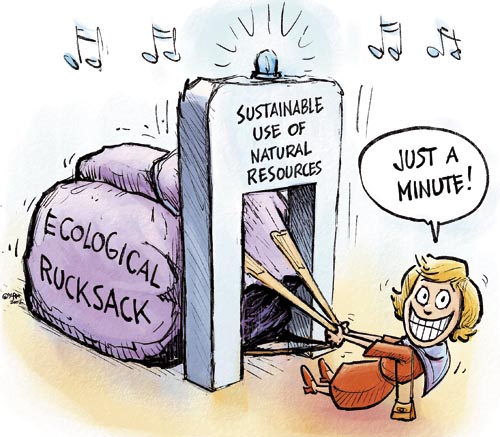
One of the main reasons that can explain the current European economic crisis are something as simple –yet complicated- as indicators. The quest for GDP growth has driven the EU countries through very unsustainable paths. Indeed current indicators give an extra bonus to a throw-away society; for every piece of waste we generate, a new process of extraction, processing, transport, manufacture and disposal is triggered which the increases the economic activity making GDP grow. This explains the obsession for consumption of throw-away goods; the more garbage we produce the better for the economy! But this is true only when measured with traditional indicators. Common sense tell us that producing more waste can not be good for the economy, but according to current indicators it is.


For instance, if we stop buying bottled water in single-use packaging and change to tap water or if we start replacing single-use plastic bags for reusable bags we will be reducing economic activity as it is measured with traditional indicators. There is obviously something wrong with our indicators if sustainability features as a minus and not as a plus.


In the long run, unsustainable practices end up harming the economy so badly that even traditional indicators such as GDP show it but then it is often too late to act. Climate change is a good example of this; there is scientific consensus that global warming is taking place but too often measures to mitigate it they depress traditional indicators such as GDP growth -despite improving sustainability!-. Another example, home composting captures carbon, builds top soil, saves transport, collection & transport emissions and educates society but from the point of view of GDP incineration of organic waste features better despite vastly increasing CO2 emissions & wasting energy in the collection and burning.


There is no discussion on the need to replace or complement GDP as an indicator, the discussion is which indicators to chose: UNEP and the UNU-IHDP presented the Inclusive Wealth Index in June which measures wealth using countries’ natural, manufactured, human and social capital, and which is intended as a replacement to Gross Domestic Product (GDP) and the Human Development Index (HDI). Also the European Commission has been working on indicators in the Beyond GDP, measuring progress, true wealth, and the well-being of nations. Many environmental indicators can be found here. Friends of the Earth also proposes indicators to measure Resource Use.


However the EU is still stuck in old and failed ways of measuring economic activity and the current debate on austerity vs growth can’t be more missleading and self-defeating. It is time to replace or strongly balance GDP with a new indicator such as the IWI which takes into account sustainability and natural capital. The moment that takes places Zero Waste will be given a major push and landfills and incinerators will be a bit more buried into history.

 
READ MORE - How to measure sustainability?
Rabu, 27 Juni 2012

Join the 3rd of July International bag-free day!

Can you imagine a Zero Waste world in which we continue to use single-use plastic bags? It is just not possible, right? There are several reasons why we should phase out single-use plastic bags in Europe.

Europeans overwhelmingly support a ban on single-use plastic bags and the European Commission tried to push such a measure during 2012 but it was stopped by the interests of some member states and a part of the industry. Yet another reason to continue asking for such a ban at national and international level.

On July 3rd takes place the  third international Plastic Bag-Free Day organised by GAIA, Zero Waste Europe and the Fundació Prevenció de Residus i Consum.

In Brussels EEB, GAIA and Seas At Risk have issued a Press Release asking the European Commission to ban single-use plastic bags.

What can you do?

Be creative with the way you want to put forward your demands. If you need some inspiration here you have some hints:

If you are an association/organisation:

* Organise a “Your bag or your life” action and  let us know here. We will be compiling the actions taking place all over the world and collect pictures, stories, etc to share with all and we will coordinate a global press release.
* Spread the 3 July Statement, International Day Free Bags
* Refuse to take disposable bags and promote the use of reusable bags: Everyday but especially on July the 3rd!
* Upload the logo of the campaign to your website/blog. See Section Artwork
* Joint press release of July 3 (soon to be published in the Press section).
* Promote the action in your facebook page.
* Organize a workshop for your associates promoting the cloth bag.
* Organise a workshop with children on the topic. Promote it in schools.

If you are a local/regional/national authority

* Make public statement on 3 July Statement
* Approve an ordinance to ban/reduce the use disposable bags
* Upload the logo of the campaign to your website/blog. See Section Artwork
* Tell media to cover events. Promote the action in your facebook page/blog.
* Take a picture of someone important in the institutions taking the plastic bag out of his/her head and use it as a promotion tool.
* Distribute reusable bags to shops and a flyer proposing alternatives to the use of single-use plastic bags.
* Joint press release of July 3.
* Organise a workshop with children on the topic. Promote it in schools.

If you are an individual

*Give your support to the action by signing up this statement. We will be gathering global support in favour of phasing-out plastic bags.

* Get together with your organisation, friends, family, neighbours, etc and organise a “Take the bag out of your head” action. If you do so please let us know here. We will be compiling the actions taking place all over the world and collect pictures, stories, etc to share with all and we will coordinate a global press release.

You can find graphic resources and ideas for your actions here.

You can join the facebook campaign here.

When?

The actions will take place from 1st till 8th of July, however the bag-free day stays on the 3rd of July. Please let us know beforehand if you are planning to organise an action.

Why?

There are many reasons! Here you have some:

http://www.zerowasteeurope.eu/2012/01/overwhelming-support-in-the-eu-for-plastic-bag-ban/

http://www.zerowasteeurope.eu/phasing-out-single-use-plastic-bags/

http://noplasticbags.blogspot.com/

http://culturechange.org/e-letter-plastics.html

http://www.envirosax.com/plastic_bag_facts

Please join this global action and promote it among your friends. Together we can get rid of single-use plastic bags and get closer to Zero Waste!

READ MORE - Join the 3rd of July International bag-free day!

Selasa, 26 Juni 2012

David Andersen Copenhagen; designing waste out of fashion

Waste is a human invention and as such it is up to us to design it out of the system. David Andersen is a good example of how zero waste can be built into a production process and at the same time bring added value to the project.

The Zero Waste philosophy has many applications in the production process and fashion is one of them. Zero Waste & clothes design can be approached from the quality point of view; i.e. better quality + good design = longer lasting clothes which should reduce the shopping frequency and hence reduce also the waste associated clothes production. Good quality fabrics also allow for refurbishment and reuse of clothes to give a second life to garments.


Another way to approach Zero Waste & clothes is from the point of view of the design. Most clothes-production processes involve lots of cutting the by-product of it being lots of unused fabric that go to waste. These fabric-rests can and should be reduced to zero and this can be done with good design.


David Andersen Design, a successful Copenhagen design label since 2007, has decided to go follow the Zero Waste path. As David Andersen puts it ’’Sustainability is an integrated part of how we work at David Andersen, and has been it for a long time. It is a simply a natural thing for us, to be concerned of the origin, production and maintenance of clothes. It should be a common and decent behavior, and not something new and fashionable.’’


Implementing Zero Waste to cloth design means creating a strong garment whilst efficiently utilising the 100% of the fabric used in production. Indeed, the idea is to design in a way that enables to use every single square millimeter of the fabric. It is the virtue of the designer, to create simple designs, so even the thinnest part of the fabric, will be integrated in the final design, thus eliminating waste.


’’It is all about minimizing waste already in the design and production phase, and about applying the approach for the next design process. In the end, the final result will signal both a design and social point of view’’ says David Andersen about the design experiment, which will be an integrated part of the designer’s SS 13 collection. The collection will go under the name of zero-waste by David Andersen.


With this project and building on smart designs, which are based on the sustainable principles from the beginning, David Andersen aims at creating a new trend within fashion. Unlike the fashion industry, which operates in secrecy, the zero-waste project is open for anyone, who is interested in following and commenting on the project. To follow the project just follow the blog: www.zero-wastebydavidandersen.com


READ MORE - David Andersen Copenhagen; designing waste out of fashion

Selasa, 19 Juni 2012

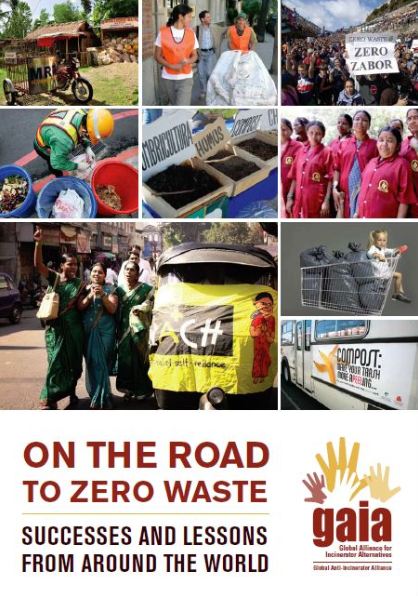
On the Road to Zero Waste: Lessons from around the world

Zero Waste is happening all over the world. To prove it GAIA presented a serie of success stories from around the globe in a Side Event in Rio+20 negotiations.

The publication "On the Road to Zero Waste: Successes and lessons from around the world" compiles 9 examples of how to make Zero Waste happen regardless of the geographical, socio-economical and political context.

It shows that when there is political will there is always a way to reduce waste generation, increase recycling and continue to shrink the fraction that cannot be composted or recycled. There are many reasons for the success of these case studies but what they all have in common is intensive prevention and source separation policies and flexible and decentralised, low-tech waste treatment systems. They are all more cost-effective and generate more employment than systems built around big incineration and landfills.

Here you have some highlights of the studies:

 
• Through incentives and extensive public outreach, San Francisco has reduced its waste to landfill by 77 percent—the highest diversion rate in the United States—and is on track to reach 90 percent by 2020.

 
• A door-to-door collection service operated by a cooperative of almost 2,000 grassroots recyclers in Pune, India, has been integrated into the city’s waste management system and diverts enough waste to avoid 640,000 tons of greenhouse gas emissions annually.


• Aggressive standards and incentives for both individuals and businesses in the Flanders region of Belgium have achieved 73 percent diversion of residential waste, the highest regional rate in Europe.


• In Taiwan, community opposition to incineration pushed the government to adopt goals and programs for waste prevention and recycling that were so successful that the quantity of waste decreased significantly even as the population increased and the economy grew.


• An anti-incinerator movement in the Spanish province of Gipuzkoa led to the adoption of a door-to-door waste collection service in several small cities that has reduced the amount of waste going to landfills by 80 percent.


• In Alaminos, Philippines, a participatory, bottom-up approach proved that communities have the ability to solve their own waste management problems.


• In Mumbai, India, and La Pintana, Chile, a focus on organics has produced real value from their largest and most problematic portion of municipal waste.


• In Buenos Aires, by organizing into cooperatives and taking collective political action, grassroots recyclers called cartoneros have gotten the city to adopt separation of waste at source, an essential step toward its goal of 75 percent diversion by 2017.


The exercise to compile these world best practices will continue in the GAIA website and hence this list is not exhaustive. There are a lot more Zero Waste practices around the world. In Europe there are many communities that are driving the change to a zero waste society and which this website is presenting little by little.


To download the publication and learn how these communities managed to change the status-quo and become best practices click here.


READ MORE - On the Road to Zero Waste: Lessons from around the world

Kamis, 24 Mei 2012

The European Parliament votes in favour of almost Zero Waste for 2020!

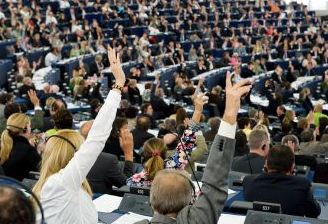
Today -24th May 2012- the European Parliament (EP) passed a resolution on a Resource Efficient Europe which, if implemented, could put the EU on the road for Zero Waste for 2020.


In this resolution the EP joins the European Commission in expressing the need to bring residual waste close to zero and consequently calls on the European Commission to make proposals by 2014 with a view to gradually introducing a ban on landfill in Europe and for the phasing-out by 2020 of incineration of recyclable and compostable waste (point 33)


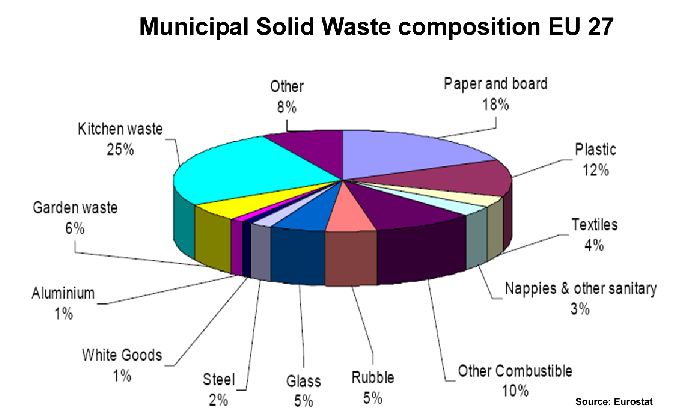
As you can see in the graph on the left, currently 80% of the municipal solid waste in Europe is recyclable or compostable and if the ecodesign directive is boosted in the way the EP asks for in point 5, it is likely that non-recyclable, non-compostable products by 2020 will be less than 5% of total MSW. Hence, this practically means the end of waste disposal in Europe.


It also urges the European Commission to agree by 2013 on clear, robust and measurable indicators for economic activity that can take account of climate change, biodiversity and resource efficiency from a life-cycle perspective. (point 2)


This resolution paves the way for radical changes in how waste is managed in Europe but let’s not forget that no legal binding measures have been taken yet. Currently:

- implementation of EU waste legislation is rather poor in most member states,

- the market incentives and subsidies in Europe go to finance incineration and not prevention or recycling,

- energy generation has priority before energy saving (i.e. if you burn paper you get subsidy for renewable energy if you recycle it there is no prime or subsidy),

- it is not compulsory to separately collect biowaste or even guarantee the quality of the compost


So, institutionally now we have all the declarations of intentions on the side of Zero Waste, time to make the EU waste legislation fit for the challenge!


READ MORE - The European Parliament votes in favour of almost Zero Waste for 2020!

Senin, 21 Mei 2012

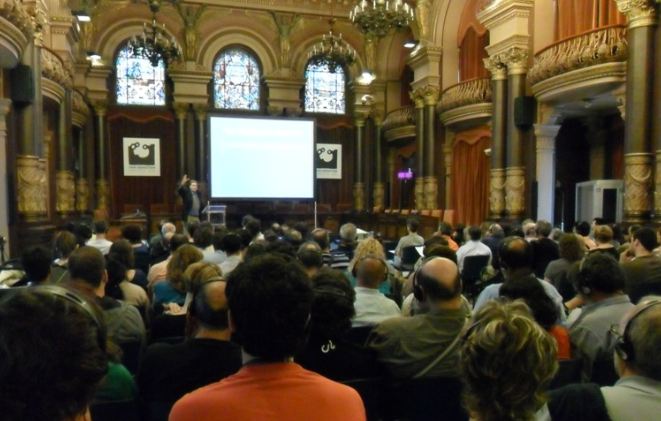
Succesful ZWE congress in Donostia!

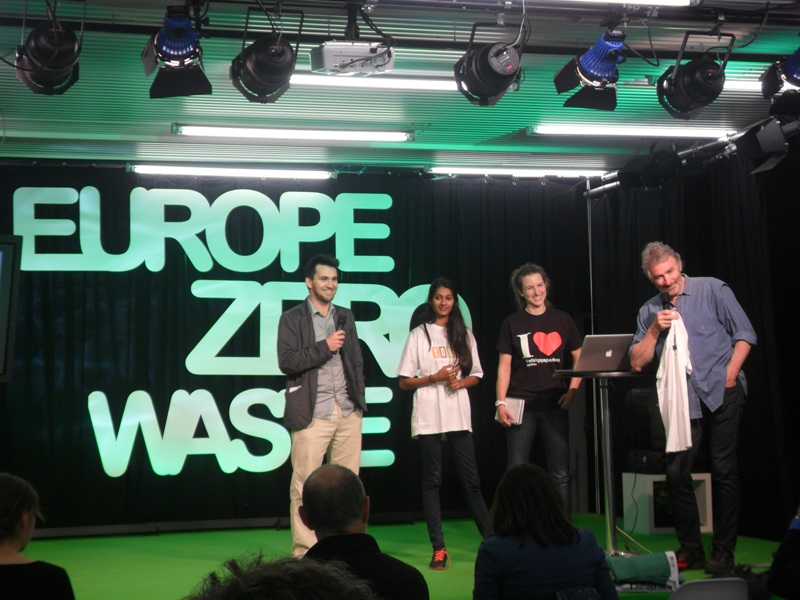
Last weekend the Congress of Zero Waste Europe was held in Gipuzkoa. Representatives from all over Europe together with guests from the US and India came together to exchange best practices and define next steps for the Zero Waste movement in Europe.

The event was a success of participation and also media coverage; 30 international representatives from all over Europe, more than 30 mayors, including the mayor of San Sebastian, the top regional authorities including the first councilor of Gipuzkoa and the councilor for the Environment, as well as many local zero waste activists and citizens. All in all, during the 3 days of the event more than 300 people assisted the ZWE congress!

During the event the participants visited succesful experiences such as Usurbil and Hernani, leading separate collection municipalities in the peninsula as acknowledged by the website of the spanish ministry of environment.

The city of San Sebastian welcomed the Zero Waste guests with an open conference in the  City Hall which was filled to the brim to listen to Professor Paul Connett during almost 3 hours.

One full day was devoted to lectures, debates and workshops in which it was discussed how to implement zero waste policies, how to evaluate them and how to bring people together to build a world without waste.

In this occasion there were presentations from the Italian, Catalan and Basque zero waste networks but many new groups expressed interest to start building zero waste networks in their home countries.

The Zero Waste Europe network committed to continue rallying municipalities around the Zero Waste goal, to promote certification of Zero Waste companies in Europe and to motivate the youth to join the movement to free their future from waste.

READ MORE - Succesful ZWE congress in Donostia!

Selasa, 08 Mei 2012

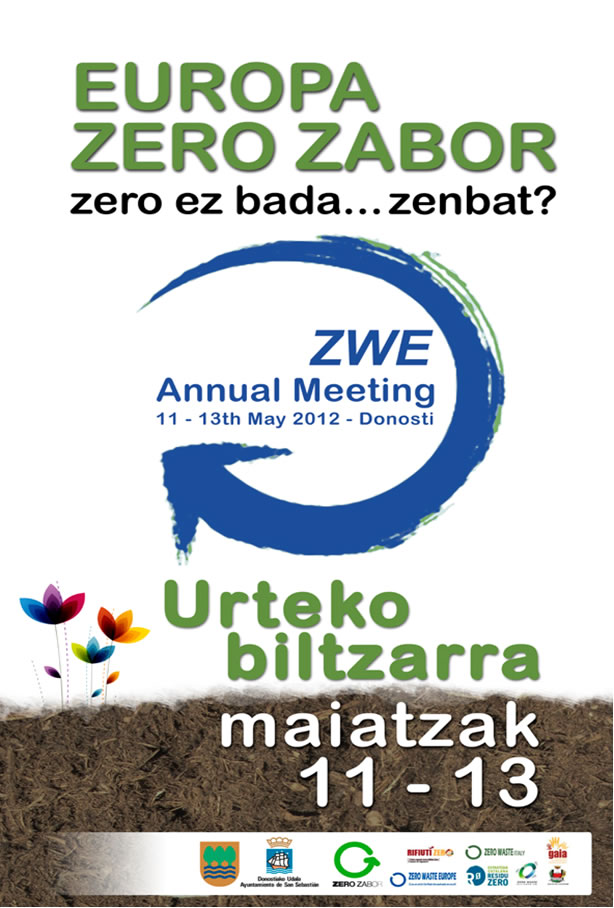
Zero Waste Europe Congress in Gipuzkoa


Program in Euskera click here.

Complete program in English click here.


Programme


Friday 10th


Friday morning - visit to Usurbil & Hernani pioneer municipalities in Gipuzkoa in the implementation of door-to-door separate collection with results of more than 85% waste diversion.

19h Open Conference in the Donostia City Hall:

On the road to Zero Waste – a new paradigm in resource and waste management

Dr Paul Connett, Professor Chemistry at St Lawrence University

19h Open Conference in Arrasate - Mancomunidad de Debagoiena: The Zero Waste experience in Europe
Joan Marc Simon, Coordinator Zero Waste Europe

Saturday 11th


Casa de Cultura del Palacio de Aiete (Donostia-San Sebastian)

-          Welcome by the Diputación de Gipuzkoa – Juan Karlos Alduntzin, Diputado de Medio Ambiente Diputación de Gipuzkoa.

-          10 steps to  Zero Waste, a strategy for municipalities – Dr. Paul Connett, Prof. St Lawrence University.

-          Experiences of optimisation of separate collection schemes and maximisation of material recovery and biological stabilisation of residual Waste before landfill - Enzo Favoino, Scuola Agraria del Parco di Monza (SAPM).

-          Presentation of experience of Italian Zero Waste municipalities - Rossano Ercolini, coordinator of Italian network of Zero Waste municipalities.

-          Presentation of experience of Catalan Zero Waste municipality. Josep-Lluís Moner, member of Catalan Zero Waste Strategy.

-          Presentation of experience of municipality in Euskal Herria – Xabier Mikel Errekondo, Member of the Spanish Parliament and former mayor of Usurbil.

-          Building a European network of Zero Waste municipalities – Joan Marc Simon, Coordinator of Zero Waste Europe.


Afternoon and Sunday 13th: Internal Congress Zero Waste Europe


READ MORE - Zero Waste Europe Congress in Gipuzkoa