Tampilkan postingan dengan label Zero Waste. Tampilkan semua postingan

Senin, 09 Juli 2012

How to measure sustainability?

[caption id="attachment_1181" align="alignright" width="300"] www.seppo.net[/caption]

Is Zero Waste good for the economy? Sure it is! Does it show in current indicators? Mmm... not always. What’s wrong here?


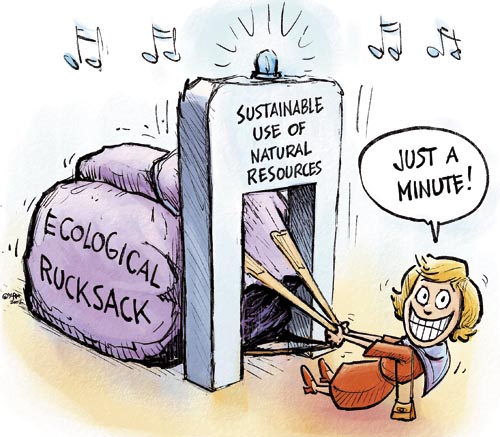
One of the main reasons that can explain the current European economic crisis are something as simple –yet complicated- as indicators. The quest for GDP growth has driven the EU countries through very unsustainable paths. Indeed current indicators give an extra bonus to a throw-away society; for every piece of waste we generate, a new process of extraction, processing, transport, manufacture and disposal is triggered which the increases the economic activity making GDP grow. This explains the obsession for consumption of throw-away goods; the more garbage we produce the better for the economy! But this is true only when measured with traditional indicators. Common sense tell us that producing more waste can not be good for the economy, but according to current indicators it is.


For instance, if we stop buying bottled water in single-use packaging and change to tap water or if we start replacing single-use plastic bags for reusable bags we will be reducing economic activity as it is measured with traditional indicators. There is obviously something wrong with our indicators if sustainability features as a minus and not as a plus.


In the long run, unsustainable practices end up harming the economy so badly that even traditional indicators such as GDP show it but then it is often too late to act. Climate change is a good example of this; there is scientific consensus that global warming is taking place but too often measures to mitigate it they depress traditional indicators such as GDP growth -despite improving sustainability!-. Another example, home composting captures carbon, builds top soil, saves transport, collection & transport emissions and educates society but from the point of view of GDP incineration of organic waste features better despite vastly increasing CO2 emissions & wasting energy in the collection and burning.


There is no discussion on the need to replace or complement GDP as an indicator, the discussion is which indicators to chose: UNEP and the UNU-IHDP presented the Inclusive Wealth Index in June which measures wealth using countries’ natural, manufactured, human and social capital, and which is intended as a replacement to Gross Domestic Product (GDP) and the Human Development Index (HDI). Also the European Commission has been working on indicators in the Beyond GDP, measuring progress, true wealth, and the well-being of nations. Many environmental indicators can be found here. Friends of the Earth also proposes indicators to measure Resource Use.


However the EU is still stuck in old and failed ways of measuring economic activity and the current debate on austerity vs growth can’t be more missleading and self-defeating. It is time to replace or strongly balance GDP with a new indicator such as the IWI which takes into account sustainability and natural capital. The moment that takes places Zero Waste will be given a major push and landfills and incinerators will be a bit more buried into history.

 
READ MORE - How to measure sustainability?
Selasa, 19 Juni 2012

On the Road to Zero Waste: Lessons from around the world

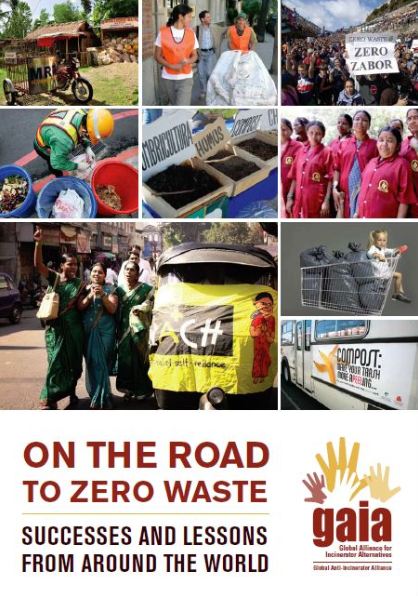
Zero Waste is happening all over the world. To prove it GAIA presented a serie of success stories from around the globe in a Side Event in Rio+20 negotiations.

The publication "On the Road to Zero Waste: Successes and lessons from around the world" compiles 9 examples of how to make Zero Waste happen regardless of the geographical, socio-economical and political context.

It shows that when there is political will there is always a way to reduce waste generation, increase recycling and continue to shrink the fraction that cannot be composted or recycled. There are many reasons for the success of these case studies but what they all have in common is intensive prevention and source separation policies and flexible and decentralised, low-tech waste treatment systems. They are all more cost-effective and generate more employment than systems built around big incineration and landfills.

Here you have some highlights of the studies:

 
• Through incentives and extensive public outreach, San Francisco has reduced its waste to landfill by 77 percent—the highest diversion rate in the United States—and is on track to reach 90 percent by 2020.

 
• A door-to-door collection service operated by a cooperative of almost 2,000 grassroots recyclers in Pune, India, has been integrated into the city’s waste management system and diverts enough waste to avoid 640,000 tons of greenhouse gas emissions annually.


• Aggressive standards and incentives for both individuals and businesses in the Flanders region of Belgium have achieved 73 percent diversion of residential waste, the highest regional rate in Europe.


• In Taiwan, community opposition to incineration pushed the government to adopt goals and programs for waste prevention and recycling that were so successful that the quantity of waste decreased significantly even as the population increased and the economy grew.


• An anti-incinerator movement in the Spanish province of Gipuzkoa led to the adoption of a door-to-door waste collection service in several small cities that has reduced the amount of waste going to landfills by 80 percent.


• In Alaminos, Philippines, a participatory, bottom-up approach proved that communities have the ability to solve their own waste management problems.


• In Mumbai, India, and La Pintana, Chile, a focus on organics has produced real value from their largest and most problematic portion of municipal waste.


• In Buenos Aires, by organizing into cooperatives and taking collective political action, grassroots recyclers called cartoneros have gotten the city to adopt separation of waste at source, an essential step toward its goal of 75 percent diversion by 2017.


The exercise to compile these world best practices will continue in the GAIA website and hence this list is not exhaustive. There are a lot more Zero Waste practices around the world. In Europe there are many communities that are driving the change to a zero waste society and which this website is presenting little by little.


To download the publication and learn how these communities managed to change the status-quo and become best practices click here.


READ MORE - On the Road to Zero Waste: Lessons from around the world

Jumat, 09 Maret 2012

Zero Waste & Taxes – shift from labour to resource use

How much is your waste worth? Are prices real? Sure you’ve asked yourself how can apples that have travelled 6,000km be cheaper than apples produced 20km away... What about salaries? What does this have to do with waste?


Well, waste markets, like any other market follow price signals. If the cheapest option is to landfill or burn waste it should not surprise anyone that recycling doesn't take off. For instance, in countries such as Bulgaria, Portugal or Slovakia the average cost of landfill is below 20eur per ton which is a bad incentive to bother separating waste to recycle it.

Prices are a human convention that serve the purpose of sorting preferences. Therefore when we want to change the reality we can use taxes to get the price incentives change the preferences. This is why many EU countries have put taxes on landfill and incineration in order to make reuse and recycling more economically preferrable.


But Zero Waste is not only about waste; it is also about the material cycles. If resources are cheap the incentive to run a throw-away society is higher, if materials are more expensive the incentive go in the direction to build a circular economy. The usual thinking regarding economic incentives is that taxes should be placed on the scarce resources in order to limit its use whereas the abundant resource can remained untaxed. During the last century labour has been scarce whereas resources have been considered abundant and this is why traditionally the former has been taxed and the latter hasn’t. The current economic crisis in Europe shows that we are doing things wrong; as the unemployment statistics show labour is abundant -yet heavily taxed!- whereas resources are not taxed albeit growing increasingly scarce. Isn’t it time to shift taxation from labour to resources?

When that happens we will see an explosion in the reuse and repair market and the cost of materials will force built-in repairability, reusability, durability and recyclability in any product. It will also make the a lot more relevant the Extended Producer Responsibility concept because producers will be a lot more interested in getting the materials back and closing material and energy cycles.


In comparison to other world regions, the EU has almost exhausted its resources. The oil-peak took place in 2006 and the energy sources based on fossil fuels are in absolut decline; from now on importing products and resources from the rest of the world will become more and more expensive and the EU needs to prepare for this new economic climate. Waste is increasingly becoming a sign of inneficiency that we can no longer afford.


The growing scarcity of materials and fuels is calling for a taxation shift from labour to materials. It would generate employment, probably increase revenues for the state and surely help to redesign the economy and phase-out waste.

In this video below Walter Stahel explains how the new economy needs to move from taxing labour to taxing resources.
READ MORE - Zero Waste & Taxes – shift from labour to resource use

Senin, 06 Februari 2012

Creation of the association of Italian Zero Waste communities in Capannori, Italy

Last weekend (3-5/02/12) mayors and representatives of Italian Zero Waste municipalities met in Capannori, Italy, to formally create the association of Italian Zero Waste communities.
Despite the difficult weather conditions which made it impossible for some representatives to participate in the event, the turnout was very good and balanced with mayors coming from the northest region of Piemonte to the southest region of Sicily.

Currently 72 municipalities -2,2 million inhabitants- have joined the Zero Waste strategy in Italy. All in all, around 4% of the population of the country are now in the road towards Zero Waste!

The Zero Waste strategy in Italy started in 2007 when Capannori declared the Zero Waste goal for 2020, in this declaration Capannori was committing to:
- Increase the separate collection of waste to 75% for 2015,
- Introduce a fee for the non-recyclable waste –Pay-As-You-Throw system-,
- Create at least one repair & reuse centre,
- Phase out incineration and landfill,
- Prioritise waste prevention with special emphasis on the extended producer responsibility.

Since then, Capannori has not only accomplished these goals -82% separate collection in 2011 and inaugurated the repair & reuse centre and a ZW research centre- but has managed to rally more than 70 other municipalities to create what will be the association of Zero Waste Italian communities.

The event was also attended by organisations, activists and experts which highlighted the social and economic benefits of Zero Waste. A couple of examples of how Zero Waste helps the economy, culture and society as much as it helps the environment;


First experience; the association of hotels of the famous Island of Capri presented their initiatives to radically reduce waste generation in the hotels and hence the tourist sector. In this pilot project 3 hotels have replaced all water plastic bottles –a normal hotel uses 20.000 bottles per year-, all the soap dispensers are now refillable and the newspapers are only available in tablets instead of paper. The waste separate collection rates in Capri are already above 70% but these prevention measures help reduce the disposal costs.

Second experience, the mayor of the municipality of Castelbuono, Sicily, explained about the successful experience of reintroducing donkeys to do the collection in the narrow, steep streets of the old town. Using donkeys is not only cheaper than using trucks, it also helps reintroduce the typical Sicilian endangered breed of Ragusa whose milk –donkey’s milk is the closest to human milk- is known to be beneficial for those who suffer allergy to cow’s milk protein allergy. Because of its energy and its friendly nature these donkeys are also employed in recreational and therapeutic activities as well as traditional events and local feasts.

These kind of best practices were shared during the event in an atmosphere of creativity, cooperation, commitment and inspiration. From now on there will be periodical meetings in order to organise together the better implementation and the expansion of the Zero Waste network in Italy and in Europe.
READ MORE - Creation of the association of Italian Zero Waste communities in Capannori, Italy

Selasa, 20 September 2011

New EU's Resource Efficiency roadmap points in the Zero Waste direction

The EU has an ambiguous policy when it comes to Zero Waste; on one hand it promotes recycling and separate collection and on the other hand it rewards energy generation from burning waste more than it rewards energy savings from prevention. In a former post we have highlighted these contradictions of EU's waste policies. But the Resource Efficiency Roadmap published on the 20th September 2011 hints new ambitions for the EU to move towards a Zero Waste Europe.

The roadmap has a strong push towards "residual waste close to zero"  -although there is no definition of residual waste at EU level-  and it underlines that "incineration with energy recovery should be limited to non recyclable materials, landfilling is virtually eliminated and high recycling is ensured". A portion of the text reads:

"Milestone: By 2020, waste is managed as a resource. Waste generated per capita is in absolute decline. Recycling and re-use of waste are economically attractive options for public and private actors due to widespread separate collection and the development of functional markets for secondary raw materials. More materials, including materials having a significant impact on the environment and critical raw materials, are recycled. Waste legislation is fully implemented. Illegal shipments of waste have been eradicated. Energy recovery is limited to non recyclable materials, landfilling is virtually eliminated and high quality recycling is ensured.
The Commission will: ...
• Review existing prevention, re-use, recycling, recovery and landfill diversion targets to move towards an economy based on re-use and recycling, with residual waste close to zero (in 2014);
• Ensure that public funding from the EU budget gives priority to activities higher up the waste hierarchy as defined in the Waste Framework Directive (e.g. priority to recycling plants over waste disposal) (in 2012/2013);"

Full text of the Resource Efficiency Roadmap here

As explained in a previous post recycling is not enough and we need to move towards a Zero Waste economy, i.e. we have to reduce our resource use whilst making sure everything produced is recyclable and recycled. The EU is now starting to do the shift from being a Recycling Society to a Zero Waste Society. However, right now the Resource Efficiency Roadmap are just a pile of inspiring statements and visions, that need to be put into action. In order to do so lots of policy changes -such as increasing recycling targets or mandating separate collection of organics-  will have to take place and it is then when we'll see how serious we are about a Zero Waste future.

 
READ MORE - New EU's Resource Efficiency roadmap points in the Zero Waste direction

Selasa, 08 Maret 2011

Constitution of the Catalan Zero Waste strategy (Residu Zero) in Barcelona

Following the example of Italy and the UK, last Friday 4th of March took place in Barcelona, Catalonia, Spain, the succesful launch of the Zero Waste catalan strategy!

More than a hundred people representing local organisations, companies, universities and research centers gathered for a whole day to discuss the goals and aims and set up the forum for a Zero Waste strategy in Catalonia. Note that in Spain the waste management is a delegated competence and Catalonia –like any other spanish autonomous region can decide on waste management-.

This initiative was possible thanks to the colaboration of all catalan universities, the association of municipalities for door-to-door collection, municipalities already developing the model of “Residu Mínim” (minimum waste) and the local and international organisations such as GAIA, CAPS, Ecologistes de Catalunya, Cepa and other members of the steering committee.

In the conference we had the chance to learn about the best zero waste practices in the world (such as San Francisco in the US or Kovalam in India) as well as european best practices such as the first European Zero Waste town; Capannori. Rossano Ercolini from the Rete Italiana di Rifiuti Zero and head of the Zero Waste Research Center in Capannori was present to explain the success of the italian experience.

The “Estratègia Catalana pel Residu Zero” (the Catalan Zero Waste Strategy) will organise sinergies between academics, practitioners, policy-makers and civil society to channel the change of paradigm from a recycling society towards a zero waste society. In this sense, the catalan ZW strategy wants to advance in the direction of a more efficient management of resources, more environmental justice and de-carbonisation of the economy.

The Catalan Zero Waste strategy is born in a context of insustainability in the management of municipal, construction and demolition and industrial waste.

Catalonia, despite very good scattered practices of high separate collection in some towns, still sends 70% of its waste to disposal which represents a clear inneficient use of materials, a lot of avoidable GHG emissions and a threat for the health of the citizens.

The solution is not to build new incinerators or burn municipal waste in cement kilns but rather to work on the replication of the best practices of separate collection (in some cases above 80%) in order to increase prevention and recycling.
A change of paradigm is necessary and this is exactly what the citizen driven Catalan Zero Waste strategy pursues.

In the meeting it was discussed that Zero Waste meant:
- Advancing towards a circular economy in which waste can become the raw material of the future,
- Avoid the generation of any waste that can be avoided
- Ban the disposal of any waste that can be reused, recycled or composted
- The redesign and substitution of those wastes which can’t be reused, recycled or composted.

The Catalan Zero Waste strategy proposes to:

1. Invert the tendency and instead of disposing of 70% and recycling 30% reverse the trend and move towards recycling 70% and disposing of 30% for 2020. Zero Waste -less than 10kg of residual waste per capita- for 2030.

2. Set up a network of organisations, institutions, companies and universities to plan and implement this change of paradigm.

3. Promote the best local and international practices of source separation, separate collection, waste prevention, etc so that they can be replicated elsewhere in Catalonia.

4. Promote innovation in the production and legislative process in view of creating the right climate for a zero waste strategy.

5. Create a Zero Waste Research Center in which the residuals can be examined to detect failures in the design which justify a substitution for a newly designed recyclable product.

The most important thing of the event, besides the high attendance and motivation from all sectors of society, was the commitment of the participants and the concreteness on the next steps to take to make it possible to advance towards a Zero Waste future.
READ MORE - Constitution of the Catalan Zero Waste strategy (Residu Zero) in Barcelona