You can find the program of the event here.
Kamis, 15 Maret 2012
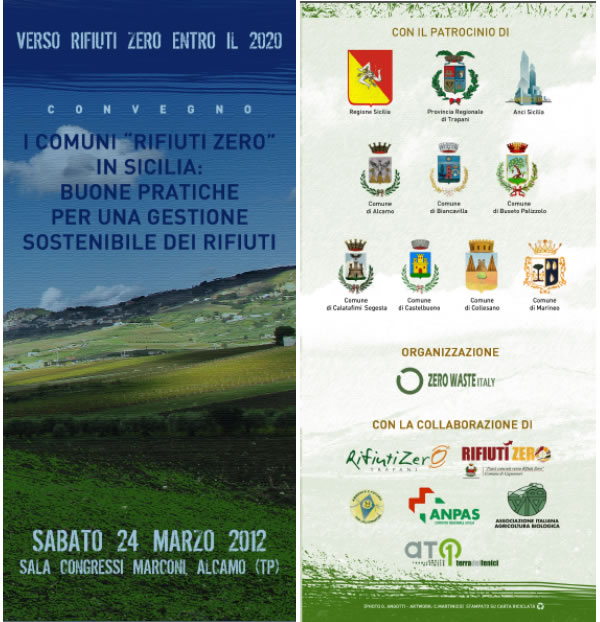
Meeting on Zero Waste good practices in Sicily, Italy
You can find the program of the event here.
Jumat, 09 Maret 2012
Zero Waste & Taxes – shift from labour to resource use
Well, waste markets, like any other market follow price signals. If the cheapest option is to landfill or burn waste it should not surprise anyone that recycling doesn't take off. For instance, in countries such as Bulgaria, Portugal or Slovakia the average cost of landfill is below 20eur per ton which is a bad incentive to bother separating waste to recycle it.
Prices are a human convention that serve the purpose of sorting preferences. Therefore when we want to change the reality we can use taxes to get the price incentives change the preferences. This is why many EU countries have put taxes on landfill and incineration in order to make reuse and recycling more economically preferrable.
But Zero Waste is not only about waste; it is also about the material cycles. If resources are cheap the incentive to run a throw-away society is higher, if materials are more expensive the incentive go in the direction to build a circular economy. The usual thinking regarding economic incentives is that taxes should be placed on the scarce resources in order to limit its use whereas the abundant resource can remained untaxed. During the last century labour has been scarce whereas resources have been considered abundant and this is why traditionally the former has been taxed and the latter hasn’t. The current economic crisis in Europe shows that we are doing things wrong; as the unemployment statistics show labour is abundant -yet heavily taxed!- whereas resources are not taxed albeit growing increasingly scarce. Isn’t it time to shift taxation from labour to resources?
When that happens we will see an explosion in the reuse and repair market and the cost of materials will force built-in repairability, reusability, durability and recyclability in any product. It will also make the a lot more relevant the Extended Producer Responsibility concept because producers will be a lot more interested in getting the materials back and closing material and energy cycles.
In comparison to other world regions, the EU has almost exhausted its resources. The oil-peak took place in 2006 and the energy sources based on fossil fuels are in absolut decline; from now on importing products and resources from the rest of the world will become more and more expensive and the EU needs to prepare for this new economic climate. Waste is increasingly becoming a sign of inneficiency that we can no longer afford.
The growing scarcity of materials and fuels is calling for a taxation shift from labour to materials. It would generate employment, probably increase revenues for the state and surely help to redesign the economy and phase-out waste.
In this video below Walter Stahel explains how the new economy needs to move from taxing labour to taxing resources.
Senin, 06 Februari 2012
Creation of the association of Italian Zero Waste communities in Capannori, Italy
Despite the difficult weather conditions which made it impossible for some representatives to participate in the event, the turnout was very good and balanced with mayors coming from the northest region of Piemonte to the southest region of Sicily.
Currently 72 municipalities -2,2 million inhabitants- have joined the Zero Waste strategy in Italy. All in all, around 4% of the population of the country are now in the road towards Zero Waste!
The Zero Waste strategy in Italy started in 2007 when Capannori declared the Zero Waste goal for 2020, in this declaration Capannori was committing to:
- Increase the separate collection of waste to 75% for 2015,
- Introduce a fee for the non-recyclable waste –Pay-As-You-Throw system-,
- Create at least one repair & reuse centre,
- Phase out incineration and landfill,
- Prioritise waste prevention with special emphasis on the extended producer responsibility.
Since then, Capannori has not only accomplished these goals -82% separate collection in 2011 and inaugurated the repair & reuse centre and a ZW research centre- but has managed to rally more than 70 other municipalities to create what will be the association of Zero Waste Italian communities.
The event was also attended by organisations, activists and experts which highlighted the social and economic benefits of Zero Waste. A couple of examples of how Zero Waste helps the economy, culture and society as much as it helps the environment;
First experience; the association of hotels of the famous Island of Capri presented their initiatives to radically reduce waste generation in the hotels and hence the tourist sector. In this pilot project 3 hotels have replaced all water plastic bottles –a normal hotel uses 20.000 bottles per year-, all the soap dispensers are now refillable and the newspapers are only available in tablets instead of paper. The waste separate collection rates in Capri are already above 70% but these prevention measures help reduce the disposal costs.
Second experience, the mayor of the municipality of Castelbuono, Sicily, explained about the successful experience of reintroducing donkeys to do the collection in the narrow, steep streets of the old town. Using donkeys is not only cheaper than using trucks, it also helps reintroduce the typical Sicilian endangered breed of Ragusa whose milk –donkey’s milk is the closest to human milk- is known to be beneficial for those who suffer allergy to cow’s milk protein allergy. Because of its energy and its friendly nature these donkeys are also employed in recreational and therapeutic activities as well as traditional events and local feasts.
These kind of best practices were shared during the event in an atmosphere of creativity, cooperation, commitment and inspiration. From now on there will be periodical meetings in order to organise together the better implementation and the expansion of the Zero Waste network in Italy and in Europe.
Senin, 30 Januari 2012
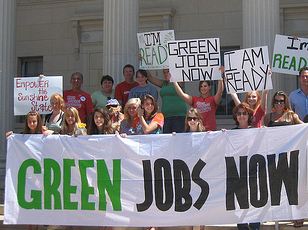
Zero Waste creates many JOBS!
In the EU we are approaching the sad figure of 24 million unemployed; in countries such as Spain almost one out of every four is jobless and this figures doubles if we look at youth unemployment. At the same time 86 million tons of waste are being sent to disposal in the EU!
The opportunities we are trashing with the current waste policies are just mind-blowing; especially when you think that half of these 86 million tons of household waste are recyclable and the other half represent a mistake of industrial design that needs to be fixed. In both cases there is a huge job opportunity; jobs in waste collection, jobs in reuse centres, jobs in repair shops, jobs in recycling, jobs in composting, jobs in designing better products, jobs in producing high quality products with recycled materials... all of these are jobs that cannot be delocalised and that we are destroying with every tone we send to landfills or incinerators.
According to a study by the European Commission 400.000 jobs can be created in Europe only if we implement the current EU waste policies. Environment Commissioner Janez Potočnik said: "We need to see waste as a resource – and to bury that resource in the ground is worse than short-sighted. This report shows that waste management and recycling can make a big contribution to economic growth and job creation. And let's not forget that recycled materials are cheaper than virgin ones – and that they reduce greenhouse gas emissions and our dependence on imports."
The E. Commission explains how the underlying problem is that too many prices do not reflect the true disposal of goods and that many member states still lack adequate infrastructure. However, one thing the E. Commission always tends to ignore is that waste-to-energy incinerators –currently burning 20% of European household waste- also destroy not only resources but also employment. A study from Greenpeace proved how recycling generates 39 times more jobs than incineration.
But expereicne shows how those towns/regions implementing Zero Waste, are being able to create a lot more jobs than those claimed by the study of the European Commission. This is because the study considers only implementation of current legislation which for instance has targets of 50% recycling for 2020. The Zero Waste municipalities work well above 70% recycling and since they have extensive policies in repairing, reusing, consumption of sustainable proximity products, etc they are managing to create a lot more jobs than the current traditional waste management strategies.
The economic crisis in Europe is setting new priorities for our societies and job creation and sustainable resource management can only be at the core of it. This is exactly what Zero Waste is about; reduce the size of your waste bin, maximise separate collection and recycling, redesign the economy, build resilient social and material systems and channel the public investment into building natural and social capital and not into landfills and incinerators.
Senin, 23 Januari 2012
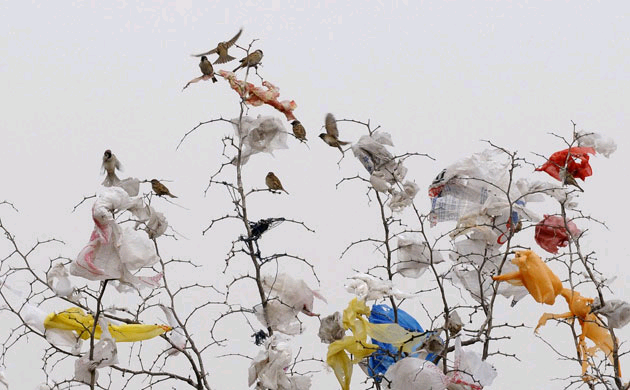
Overwhelming support in the EU for plastic bag ban
The public consultation was intended to explore options to reduce the use of plastic bags and options to improve the requirements of biodegradability under EU law.
Over 15,500 responses were gathered by the Commission with just over 15,000 replies from EU citizens.
The results of the consultation show that over 70% of respondents agree that a ban on plastic bags across the EU is needed with only 12% agreeing that current requirements on compostability and biodegradability in the Packaging Directive were appropriate.
Chris Carroll of Seas At Risk said: “Plastic bags are a menace to the marine environment and this consultation has shown that European citizens have had enough of them. The Commission must listen to this resounding support for a ban and implement one across Europe as soon as possible. The Commission must also now look at how to reduce the use of other single use and disposable products and packaging that often end up as waste in the marine environment.”
Stephane Arditi of the European Environment Bureau said: “With more than two thirds of respondents supporting a ban of single use plastic bags, a clear signal is being sent to European institutions: it’s time for longer lasting products and for effective legal instruments supporting waste prevention.“
Source: Seas at risk
Senin, 16 Januari 2012
Toxic Europe: How much is the EU doing to fight illegal waste trade – How much can Zero Waste do?
The recently awarded documentary “Toxic Europe” is a good piece of investigative journalism which uncovers a lot of dirty truths about waste management in Europe.
The documentary reveals how at least 225 million tons in the whole of the European Union escape legal treatment –it could be a lot more- and how that is linked to the low prices offered by the illegal dealers which sometimes is 4 to 5 times cheaper than the legal prices.
Indeed, the trafficking of waste traficking to internal EU borders or abroad faces lots of challenges; firstly, contrary to normal crimes, there is no interest from the parties to denounce the illegal practices because they all benefit from it. Secondly the waste flows mixed within the trade routs is so big that it is almost impossible to control. According to the documentary the customs of Antwerp, one of the biggest EU harbours, control only 2% of the waste that comes in and 1% of the waste that goes out (!).
It is badly needed that the EU takes over the control of its own borders if it is to manage illegal waste trade but once again the EU lacks the resources to do so and the member-states refuse to do so. Without more control at the borders –whose workers are very often are infiltrated by the mafia- the only way to stop waste from Germany, Denmark, Belgium, Italy, etc from being shipped abroad is by managing it locally with transparent and traceable systems. And this can only be done if we change our relation with our waste; if we separate it at source and it is properly collected and measured it is very difficult that it can later “disappear”.
So we can see how Zero Waste is not about only about sustainability it is also about democracy and rule of law. A Zero Waste strategy makes all waste very visible which makes traceability possible and effectively fights ilegal practices. Whenever waste is not separately collected or the authorities claim that they make waste “disappear” what it means is that it will end up either in an incinerator/landfill or scaping the legal routes..
Senin, 09 Januari 2012
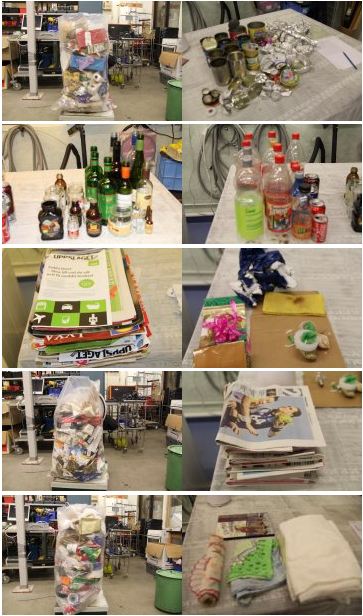
A Zero Waste month in Sweden: 4 people = less than 1kg of waste !
During one month Pål separated, measured and weighed the different waste fractions and the result has been amazing in many ways: "It was very easy, didn´t smell (careful cleaning) and you got a very good view of your waste when you look att it almost every day and that you take care, handle it not as waste but as resources. Out of almost 60 kg "waste", there were only 0,9 kg I couldn´t handle in a satisfied way (probably goes to burning or bury). I´m very happy that so little is left for the burners, there will be a lack of waste for them if everyone made my example as a habit." says Pål.
Want to check the detail?
Item dec 5-12-2011 - 3-1-2012
Paper (kg) 4,3 Recycle
Plastic (kg) 5,3 Recycle
Glas (kg/pcs) 7,9 23 Recycle
Pet (pcs) 1,3 22 Deposit
Cans (pcs) 0,8 7 Deposit
Metall (kg/pcs) 1,4 23 Recycle
Food -mostly peels, cores, coffee/tea grounds, bones, flowers...- (kg) 20,5 Compost
Commercials(kg) 3,6 paper Recycle
Newspaper(kg) 2,1 Recycle
Magazines(kg) 0,3 Recycle
Old tea(lit.) 5,9 Drain
Old coffee (lit) 2,1 Drain
Bulb (pcs) 0,1 1 Recycled
Textile (kg) 1,4 Reuse
Envelopes (kg) 0,2 Recycle/Burning
Electronic (kg) 1,2 Recycle
Rest/leftover(kg) 0,9
Burning/Bury(0,9kg rest/leftover) (candles, dishcloth, strings, tampongs,glossy paper)
59,3 kg "waste" total in one month
Therefore for a household of 4 pers and a period of one month including Christmas and New Year Pål's family has generated 60kg. 15kg per person in average where the part that could not be composted, reused or recycled was only of 1,6%!!
If we look at the Eurostat statistics for Sweden we see that in 2009 Sweden was burning 49% of its waste and landfilling 1%. This means that the average Swede generates around 40 times more waste than Pål or that most of what the Swedish waste management system is burning is actually recyclable. The answer is probably somewhere in the middle...
Of course, the experience mentioned above is not representative (besides being only one example, Pål's family generates 180kg per person/per year when the Swedish average is 480kg) but it does show the possibilities to live in a more sustainable way and how if all Swedes would follow Pål's example could afford to close down all incinerators and radically increase recycling and composting.
There are Zero Waste experiences around Europe that confirm that what Pål has done can be repeated and it shows that, after all, it is up to us to make Zero Waste possible!