Rabu, 28 Desember 2011

Zero Waste hotels initiative

The agreement between ANCI and Federalberghi Capri and Sorrento hotels for Zero Waste Federalberghi Capri and Sorrento Coast has partnered with ANCI Campania to bring their own hotel facilities sphere goal of zero waste. The philosophy of Zero Waste 2020 by Paul Connett, who visited for 4 days in Campania, therefore, was implemented in the best possible way and has resulted in a Memorandum of Understanding with the appointment of 14 ambassadors A Star for the Environment, who get involved in person to the success of the project.

Among the municipalities that have joined and Naples, for now the greatest directors, pending the accodino other cities. The idea is to extend this good practice at all the hotels and catering sector and national companies extralberghiere to initiate a virtuous cycle that cancels the production of waste.

The incentive identified, together with the obvious savings that will consume less, is given by TARSU substantial discounts, according to the principle pollute = less pay less. In fact, if you produce less waste, municipalities will have less to collect and even disappears with zero waste disposal fee for the hated.
READ MORE - Zero Waste hotels initiative

Kamis, 22 Desember 2011

Progress towards Zero Food Waste in the EU

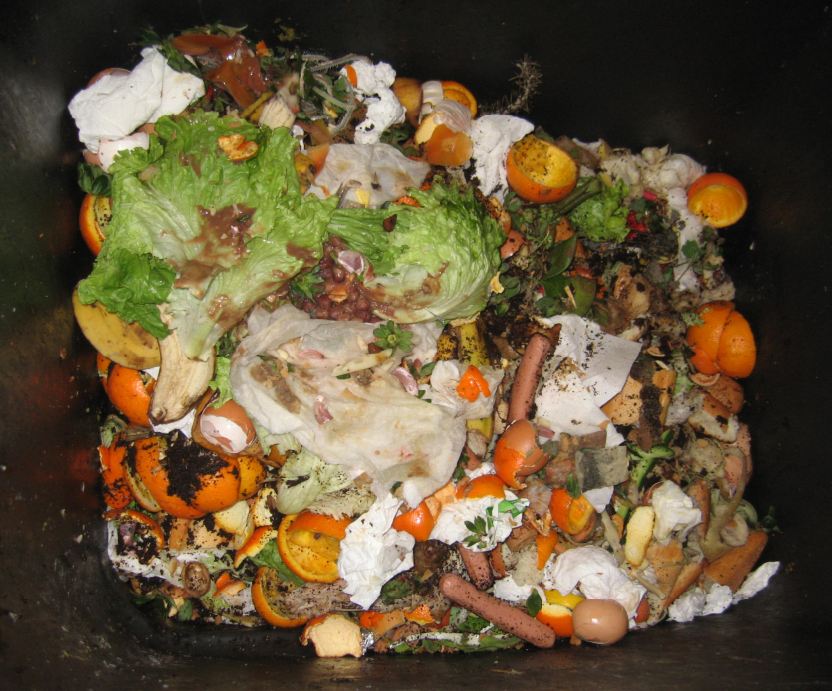
Almost 50% of edible and healthy food gets wasted in EU households and supermarkets each year while 79 million EU citizens –out of 500 million Europeans- live beneath the poverty line and 16 million depend on food aid from charitable institutions.


Food waste is many times a waste; it is a waste of resources and money, it is a waste that creates methane if landfilled and CO2 if incinerated, it is a waste when in the world one child is dying of hunger every 5 seconds ... The current food wastage in Europe does highlight the contradictions of the world we live in but it also underlines the need for a Zero Waste policy, not only in the food sector but also in other sectors.


Indeed, the current economic crisis is keeping 23 million Europeans out of the job market whereas 60% of all municipal waste in the EU is landfilled or incinerated. The employment opportunities in the design, production, repairing, reusing, collection, recycling and composting sector are very substantial if only we change the waste market in order to divert waste from incinerators and landfills.


But these are very convenient dates to tackle food waste because of the holiday season that involves lots of investment in food and a good deal of cooking at home. According to WRAP every British family is wasting 60 euros a month in food that will not be eaten.
It is because of this wastage that the EU and some member states are taking measures to try to reduce this waste.


The EU is showing the will to end with this wastage; the European Commission has proposed an indicative milestone of a 50 per cent food waste reduction by 2020 and the commissioner Janez Potocnik is vocal about the moral, economic and environmental responsibility to change the current practices.


In this line the European Parliament passed a resolution in which:
- it asks for more education to avoid excessive waste,
- it demands proper labelling and packaging of food products to show the date until which the product may be consumed –note that the label “sell-by-date” or “best before” refer to quality standards but don’t mean that the item is not edible after the date- ,
- it promotes that public institutions should favour responsible caterers that use local produce and give away or redistribute leftover food to poorer people or food banks free of charge rather than disposing of it,
- it encourages setting up systems such as the “Last Minute Market” to make sure that leftovers or non-eaten food can be used to feed people in need.


The European Commission is also addressing consumers on the issue of food waste in a recently launched campaign on resource efficiency called ‘generation awake’ . It gives tips on making the right choices when we buy and consume – including foodstuffs.


To sum up, waste prevention is paramount and it makes lots of sense that the EU is gearing up in this issue especially in the current days of growing resources scarcity. However, let’s not forget that these days most food discards in Europe still end up landfilled or incinerated causing lots of harmful emissions. Moreover, to this date the EU doesn’t require the separate collection of organics which means that the use of food scraps as soil improver after compost is not yet happening at considerable scale. Let’s not forget that organic waste is the biggest waste stream -30 to 50%- and as such it continues to be the pending issue in EU waste legislation.


Any Zero Waste strategy focuses in the importance to work at the front end to reduce food wastage and at the back end to ensure that organics are composted and not landfilled.


READ MORE - Progress towards Zero Food Waste in the EU

Rabu, 07 Desember 2011

Reuse of WEEE: widening the cycle of materials

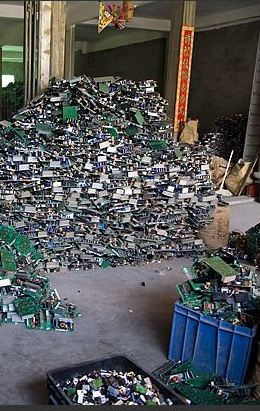
Giving a second life to products before they are –hopefully- dismantled for safe recycling is the most preferable option. Yet “some” say the demand for second-hand electric and electronic goods is low and it is better to send them to dismantle and get yourself a new one. Think twice! The opposite is true.


In many cases those who argue against reusing electric and electronic goods are the same companies that produce them and therefore have an interest in you buying a new a new one. But some other times it is true that some people just don’t want a second hand electronic appliance. What is for sure is that today there are plenty of electric and electronic goods which are discarded despite being still fully operative or easily reusable if fixed.


New data from recent studies on reuse in the EU indicate that:

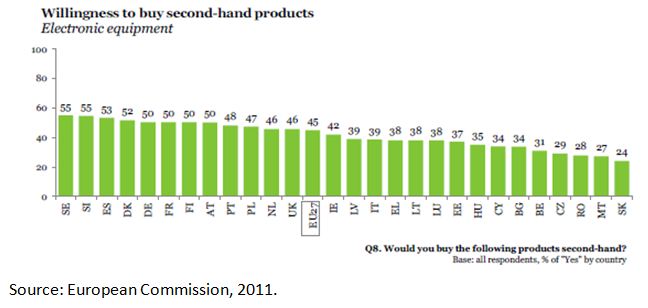
 There is strong market demand across Europe for quality second hand electronic goods. On average, 50% of people in Europe –according to a survey by Flash Eurobarometer- would be happy to buy a second hand appliance.
WEEE reuse is a significant employer opportunity particularly if carried out by social enterprises and has potential to employ 10 times more people per tonne of material processed than recycling activities.
Lack of appropriate legislation is seen as one of the main barriers to WEEE reuse activities on the ground,

Indeed, the waste hierarchy as approved in the current European legislation establishes the clear priority of preparation for reuse before recycling and disposal but unfortunately there are no targets or incentives to make this happen yet.


However in October 2011 the Environment Committee in the European Parliament voted in favour of a 5% target for reuse in the collection targets, a requirement for producers to provide information free of charge about preparation for reuse and treatment of the appliances they out in the market, requiring all collection schemes to provide for the separation of reusable WEEE at collection points and the adoption of European standards for preparation for reuse (to be created in max 3 years).


This positive outcome still needs to be approved by the EU member states before it can enter into force. So far the member state have been very reluctant to these measures and if no agreement is reached during this month of December the negotiations will have to go to conciliation which would downsize the ambition of the targets.

Given the increasing prices of raw materials, the employment opportunities linked to the reuse sector and the high energy embodied in these products it is necessary to improve collection and reuse rates of goods to get closer to a Zero Waste economy.
READ MORE - Reuse of WEEE: widening the cycle of materials

Kamis, 01 Desember 2011

Gaiakraft: Beyond paper recycling?

Few years ago paper and cardboard recycling was regarded as a big step in closing the loop of materials, yet what back then was a big improvement now it has the potential of going further. Paper recycling is a no-brainer now but there are new alternatives that are a lot more enviromentally friendly.


Followig the idea that the best waste is the waste that doesn’t exist; the best paper waste is the paper that is not produced in the first place. I.e. the inmaterialisation of the use. The concept of paperless office is a widespread reality, more and more people read the news and books on electronic platforms which are reducing the amount of newspapers, more and more cardboard packaging is being reduced... the use of paper supports can be reduced dramatically. However, it is still hard to imagine a world without paper.


The raw resource of wood pulp are trees. Both deforestation and dedicated tree plantations have shown its negative impacts not only on the environment but also on local economies. To make 1 ton of paper you need 20 trees, 60000 liters of water and a good amount of chemicals. Paper recycling is great because it reduces tree-logging yet it is a technology that is intensive in water and bleach use and hence it generates water waste and carbon emissions.


Therefore it would be necessary to work out a system that minimises water and chemicals use and emissions. And this is what the company Gaiakraft has done.


Gaiakraft has developped a system that should leave trees alone for a while and save good deal of water, emissions and chemicals. GaiaKraft bags and packaging is made from paper that comes from mineral powder (calcium carbonate) meaning it is tree-free! This tree-free paper differs from traditional paper in that it is made from a high percentage of mineral powder and a small percentage of non-toxic resin. What's more is that the process used to make the paper uses no water or bleach like traditional wood pulp paper.


GaiaKraft is water-resistant and being a tree-free paper and essentially fibreless, it does not absorb ink and therefore prints with 20-30% less ink as compared to traditional wood-pulp paper.
GaiaKraft is degradable and due to its high mineral content safely degrades when left out in nature over a period of 6 to 9 months.


Less deforestation, no water or bleach use, no toxins released, degradable, recyclable, less emissions, water resistant, uses less ink... Gaiakraft paper looks like a step forward for the future of our forests and rivers but also for the implementation of Zero Waste strategies!
READ MORE - Gaiakraft: Beyond paper recycling?

Selasa, 22 November 2011

Little Museum of Bad Industrial Design

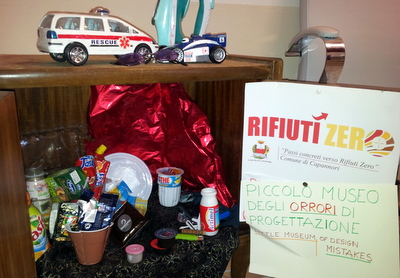
Primary school students of Capannori, Italy, set up the Museum of Bad Industrial Design (Piccolo Museo degli orroridi progettazione). A museum of packaging and products that cannot be reused, repaired, recycled or composted and hence have to end up in the dump.


This experience allowed the students to observe their everyday life and pick those things that were not sustainable. The experience was enlightening for the students but also for the grown-ups; how can we allow products to enter the market when even children can see that they are designed for the dump?


In order to enlighten the industrial designers of the big wealthy companies producing these goods the pupils wrote letters to them asking to please think about the future and produce products that could be recycled or composted at the end of their lives. As with the case of the coffee-capsules some of them replied with thank you notes and confirming their commitment to improve the design in the future.


Here is a good experience to involve children in waste prevention. The less non-reusable/repairable/recyclable stuff in the market the closer we are to Zero Waste!
READ MORE - Little Museum of Bad Industrial Design

Selasa, 15 November 2011

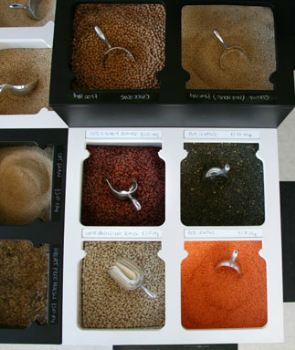
Unpackaged: shopping without packaging

Look at your home waste and you will see that it is mostly packaging. Once you have removed the food waste and paper what is left is mostly single use plastic bottles, cans, trays... Therefore, if you minimise the packaging in your shopping you will be generating less waste. Easy, uh?

Unpackaged is one of these shops in Europe that allow you to shop without having to bring home a bunch of single-use recipients and plastic bags that only harm the planet and fatten our bins. Unpackaged was founded in 2006 by Catherine Conway in the belief that there is a better way to sell products, so that customers can do the right thing – for themselves and for the environment.

Catherine set up Unpackaged because she wanted to refill her groceries using her own containers. The dream was to set up a beautiful shop that made it really easy for customers to come & refill all their daily essentials.

The website of Unpackaged explains very well why whilst some packaging is necessary in our modern industrialised food chain, unnecessary packaging is a waste because of:

Cost: It increases the price of the goods you buy. You are charged twice – first when you buy over packaged products and then through council tax for disposing of your rubbish.

Waste: It wastes resources at every level: production, storage, transport and disposal.

Pollution: Landfill and incineration are the two main ways of dealing with packaging waste. These are major pollutants for people and the environment as they release toxics and greenhouse gases.

What about recycling? While some packaging is recycled, most ends up in landfill sites and incinerators and some packaging is difficult and impossible to recycle. Recycling is certainly part of the solution, but it will only work if we use less packaging and adopt more ‘reusable’ ways of doing things – Unpackaged is based on this ethos.

This is why the mantra of unpackaged is:

Reduce by only buying what you need
Reuse by bringing your containers for a refill
Recycle what you can’t reuse

And… if you can’t reuse or recycle it then don’t buy it!

There is a growing trend in Europe but also around the world to minimise packaging. After all, when people go shopping they want to buy food, drinks, etc, they don’t want to buy packaging!
In a sensible world the producers should be interested in getting back the packaging so that they don’t lose the materials and this way they can use them again and again. This is not only how our sensible grandparents used to do it, it is also the basis of a how a deposit refilling system works or how Extended Producer Responsibility is being to be implemented in British Columbia in Canada.

Implementing Zero Waste strategies it is not only sensible and fun, it also attracts interest from the media. See these press highlights for Unpackaged:

  • Two lovely videos from CNN & Reuters which show off Unpackaged.

  • Features in many different types of publications from national newspapers to industry, design & consumer magazines – The Grocer, Which Magazine, The Independent, Style Will Save Us

  • Time Out recently voted Unpackaged the #48th best shop in London

  • Catherine was voted #32 in the Observer Food Monthly Top 40 Eco Heroes.

  • Unpackaged was included in Time Out’s ‘Little Black Book’ of the 500 most essential services in London

READ MORE - Unpackaged: shopping without packaging

Kamis, 10 November 2011

Succesful Zero Waste event in Rome

Organised by Zero Waste Lazio with the support of the Italian Zero Waste Network

Last weekend the Piazza Apostoli in Rome was filled with more than 3000 people who were asking for a Zero Waste alternative to the “Polverini local plan" which instead of reducing, reusing, composting and recycle wants to dispose of most of it.

The alternative plan proposed by the citizens puts separate collection at the center of the policy; recycling and composting what cannot be prevented or reduced and instead of resorting to mega landfills and incinerators for the remaining waste (10 to 12% of the total) it proposes that this waste should be studied and submitted to cold-treatment prior being biologically stabilized and stored in a landfill.

The Zero Waste demonstration asked not to replace the now closing dump of Malagrotta with a new mega landfill elsewhere in the Lazio province. Instead it is requested that the municipality of Rome, which represents 5/6 of the total municipal waste generated in the Lazio region, should implement door-to-door separate collection integrated with a system of reuse, repair and recycling centers.

The Italian Zero Waste Network is asking for the immediate replacement of the people responsible for this mismanagement and the return of a democratic logic that should bring back the power to the local communities and institutions.

The Italian Zero Waste network will be back to Rome on December 3rd to move forward with the local Zero Waste organisation to continue pushing for these goals. In this occasion there will be participation from people from international Zero Waste speaker, Paul Connett.

On behalf of the Italian Zero Waste network
Rossano Ercolini

READ MORE - Succesful Zero Waste event in Rome