Sony Europe has made consistent progress, with all GEMS *4-certified Sony sites throughout Europe being powered by electricity from 100% renewable sources*5 since fiscal year 2008. In terms of waste management, recycling levels have increased from 73% in fiscal year 2000 to 99% in fiscal year 2009, meaning that currently 99% of the waste generated by Sony Europe manufacturing facilities is either reused or recycled. In addition, as part of its measures to further increase producer responsibility, Sony Europe is also a founding member of the European Recycling Platform (ERP). Fully operational in 12 European countries, the ERP effectively manages end-of-life collection and recycling for all consumer electronics products across these countries. *4 Global Environmental Management System. Sony?s global environmental management system based on ISO14001. *5 Data for fiscal years 2008, 2009 and 2010 has been verified by leading global certification organization Bureau Veritas Certification (BVC).
READ MORE -
SONY ZW
Kamis, 28 Juli 2011

Kamis, 21 Juli 2011
Reusable nappies, a Zero Waste solution to an European problem
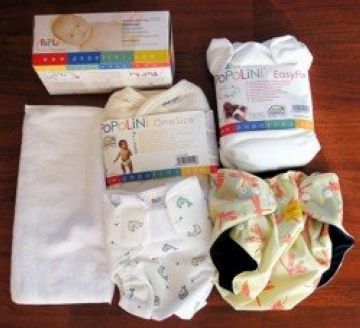 We all use or have used nappies in a time of our life. Nappies are a fairly recent invention that has eased the workload to many generations of parents –specially mothers-. Consequently, nappies are here to stay. The question is how to make its production, transport, use, re-use and disposal sustainable? What kind of nappies are suitable for a society that aims to phase out waste?
Why are single-use disposable nappies a problem?
Ca 4000 to 5000 nappies are used per child until its 3rd year of age, which equals 1tn of waste per child. Seniors also use nappies and hence generate vast amounts of highly putrescible waste. In fact, even though nappies represent only between 1 and 2% of total municipal solid waste, in the places with highest separate collection rates they represent almost the biggest fraction left in the residual waste. For instance, in Capannori , the first Zero Waste municipality in Italy , nappies represent almost 15% of the waste fraction that can’t be recycled or composted. With the increase in diversion of other waste streams and increase in the age of the Europeans that will need nappies we shall see an increase both in percentage and weight in the next years in Europe.
The problem with nappies is its high fermentability combined with the composition of the nappy –combination of plastic, cotton, creams and faeces-. This means that, firstly, disposal of the nappy in the waste bin (as mixed waste) and, secondly, forces a very frequent collection of the garbage bag -because of smells and other hazards caused by its putrescibility-.
If we could solve the problem of nappies in the waste bin it would be possible to reduce the frequency of collection which would reduce the collection and disposal costs. Moreover less nappies in landfills means less methane in the atmosphere and less impact to human health.
How to get nappies out of the waste bin?
The best way is to avoid using disposable nappies by expanding the use of reusable nappies. If we want to keep on using single-use nappies another way is to find a way to seal them so that they don’t smell and therefore can endure more time in bin. However this doesn’t solve the disposal and sustainability problems.
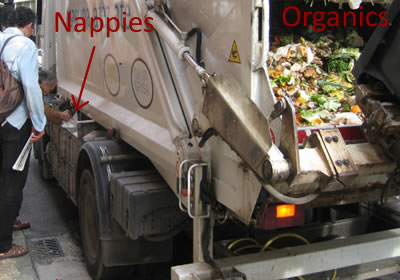 Another solution is to facilitate special bins/collection days for nappies so that they don’t contaminate the other waste in the bin and hence reduce the frequency of waste collection. This is done in most door-to-door collection systems.
Lastly, another option if we were to continue using the single-use disposable nappies would be to produce nappies with compostable bio-plastic. This does seem a solution at first hand for our busy societies. However, studies have shown high levels of zinc present in the compost, which originate from hand-creams and other additives used to avoid nappy rash. Toxins in compost speak against the option of compostable nappies.
The advantages of reusable nappies
Reusable cloth nappies have many advantages:
- they save money for the user (from 1000€ to 2000€ per baby) and to the community (less putrescible waste = possibility to reduce the frequency of collection = lower collection costs and odours). Moreover, these nappies can be re-used when the baby has grown up, meaning that they could be sold, passed on to the next child or friends/relatives!
It is also important to note that single-use nappies externalise the costs of collection and treatment to the public administration and hence to the consumer. In other words, the price of single-use nappies in the supermarket doesn’t include the costs for the society and the environment once the product leaves the shop. In the end we all end up paying for it when the company, following the polluter pays principle, should be the one shouldering these costs. If these costs would be internalised in the price the economic advantage for reusable nappies would be even bigger.
- reduces the environmental impact: 1000kg of non-recyclable waste is prevented during 3 years. Plus the production and use of reusable nappies use less than half the water, need only one eigth of non-renewable and 90% less of renewable materials, use one third of the energy and the use of soil is from 4 to 30 times less intensive.
- reduce chemical exposure for the baby: the cellulose that touches the baby’s skin is produced and bleached with chemical products that are in contact 24h with the skin which favours the occurrence of hypersensitivity.
- helps de local economy – in many cases the reusable diapers are produced locally by the community in contrast with the industrial production of single-use nappies. For instance in Capannori, Italy, local women are working from home to produce the nappies of the company. A similar case we find in Reus, Spain.
In Europe there are several good experiences of implementation of reusable nappies:
- In Flanders, Belgium, the administration co-finances the purchase of reusable cloth nappies,
- In the UK a waste minimisation campaign (The Real Nappy Campaign) was very successful in bringing this issue closer to the people. 80% of municipalities in the UK support the use of reusable nappies and effective service of nappy laundry is in place,
- in Austria 10 to 15% of the people confirm the use of reusable nappies,
- in Italy the use of reusable nappies is widespread in those communities adhering to Zero Waste,
- In Catalonia, Spain, there has been several tests to introduce reusable nappies in kindergartens which have proven to be a saving for the school –decrease in nappies use of 37% and reduction of 147kg/year per baby- and a way to promote reusable nappies among parents –many of whom decide to adopt the system at home-
It is estimated that in Europe 20% of the population uses reusable nappies -15% for economy and 5% because of environmental reasons-. The use is uneven between EU countries, some with high percentages and some with very low. What is clear is that this is a growing trend and we are going to see more of these if we are to advance towards sustainability. From the waste point of view, replacing single-use nappies with reusable nappies is the way to go if we want to reach a Zero Waste society.
Rabu, 13 Juli 2011
Puma - towards Zero Waste?
 The shoe producer Puma in cooperation with the FuseProject has set itself in the path to minimise waste and is today a reference for other companies on greening production. As Puma says in a good understanding of waste hierarchy; they make better use of boxes by not using them.
After 21 months of studying diferent options to reduce the environmental impact, minimise the use of boxes, diminish shipping costs and hence reduce waste, and after 2000 ideas and 40 prototypes Puma concluded that the best solution was not to use a box and instead use a 100% cornstarch fully biodegradable bag.
The "clever bag solution" represents a 65% reduction in the use of cardboard which means saving 8500 tones of paper,20.000 milion megajoules of electricity, 1 milion liters of fuel, oil and 500.000 liters of diesel, 1 milion liters of water and reducing CO2 emissions in 10.000 tones.
On the top of that Puma has phased-out always dangerous PVC from its shoe soles and is producing smaller handtags which also reduces paper use.
The reduction of waste in Puma has brought not only less environmental impact. It has also reduced the costs, raised the green credentials of the company which will make it more appealing to new costumers. A good example of how Zero Waste is not only possible but also highly recommendable corporate strategy!
Kamis, 07 Juli 2011
Shortsighted EU policy on raw materials delays getting to Zero Waste
 The EU is the region most dependent on foreign imports of raw materials in the world. Hence there is a genuine interest in reducing this dependency. But, are the current policies apropriate to create a close loop society in the EU? How can the Zero Waste concept contribute to this aim?
The high EU dependency on raw materials pushed the the European Commission (2008) to launch a major new strategy, the Raw Materials Initiative (RMI). It consisted of three pillars:
1- securing access to raw materials on world markets,
2- fostering the supply of raw materials from European sources
3- and reducing the EU’s own consumption of primary raw materials.
During this year the European Parliament has been working on the new RMI under lots of pressure from the industry. From the Zero Waste point of view, that would like to see all the materials entering the Union being reintroduced into the production cycle over and over (craddle-to-craddle approach), we see the policy of the EU regarding this RMI being rather shortsighted. The new RMI puts all the energy on pillars one and two, on using diplomatic and less-diplomatic means to obtain raw materials in a way that very often undermines the capacity of the global south to develop its own industry . As it stands right now the main driver of the RMI is free-trade with all its consequences, unfortunately the text contains no real means to reduce consumption of these raw materials in the EU (the EU consumes 3 times more materials than Asia and 4 times more than Africa) and no means to close the material gap that would allow the EU to increase its sustainability.
In other words, in the RMI there is almost no reference to recycling as a way to recover materials. Despite the usual nice rethoric about sustainability and the EU becoming a “recycling society” the current policy continues to be to import materials, use them to the full and let the poor and the other parts of the world deal with the waste. In the current RMI there are neither targets nor aims to measure the material flows from and to the EU. Without knowing what comes in and what comes out it is impossible to consider recycling targets as a way to recover these materials and hence reduce this dependency from abroad.
Oxfam and Traidcraft produced a good analysis of the RMI in which they rightly argue that the first priority for the EU should be to reduce its consumption of resources and move towards a low-resource economic model. This is exactly what a Zero Waste model would be; make waste disappear by making it possible to materially recover all the materials that enter the EU.
Times have changed and pursuing old-fashioned strategies based on resource extraction and peer-pressure to empoverished countries will not work anymore. Although ‘resource intensity’ (the amount of raw materials needed to produce growth) is declining globally, the absolute amount of natural resources extracted every year is increasing due to economic growth – the world extracts around 50 per cent more natural resources now than in 1980. This means that more scarce resources will get more expensive and unreachable and trying to close the loop only makes sense. Any EU policy on materials and resources that doesn’t include maximising material recovery and resource efficiency is compromising the economic future of the Union. The vote in the European Parliament's Industry Committee against resource efficiency targets is a worrying sign that can hijack the future of the EU resource efficiency strategy.
The RMI should focus a lot more on material productivity and on how to recover the materials that are already in the EU and which will end up dumped, burned or exported. A Zero Waste strategy would allow to recover these materials. In fact, most Zero Waste municipalities in Europe almost don’t send any of these precious materials to disposal.
Rabu, 29 Juni 2011
An alternative to single-use plastic bags in Europe?
 Are all single-use plastic bags the same? Do they have the same impact on the environment? Are biodegradable bags better than non-biodegradable? Are paper bags better than biodegradable plastic bags?
First things first; before focusing on the material we have to focus on the product, i.e. the best is to avoid disposable bags whenever possible. Remember: prevention is always the best option! Before the invention of plastic bags this waste stream was absolutely insignificant –composed only of those reusable bags that broke after years of use and could not be mended.
Therefore, the discussion on whether a biodegradable plastic bag is better than a non-biodegradable one is as important as it is secondary. First option is reduce, second option is recycle, third –and a sign of the inneficiency of our society- is disposal. Replacing a single-use plastic bag by a single-use biodegradable plastic-bag is not the solution, although it may help reduce the overall impact and pressures on environment.
Biodegradable vs non-biodegradable
If we have to choose between a single-use plastic bag and a single-use biodegradable plastic bag some studies claim that the bio-degradable plastic bags have a higher environmental impact but they are highly missleading. This is because of weak science; they do not consider the ecotoxicology and eutriphocation aspects of plastic. Moreover there is the problem that in these studies and other Life Cycle Assessments they tend to neglect the benefits of composting (which is the primary route for post-use management of biodegradable bags) by not integrating the positive role on soils.
EU-ban on single-use plastic bags
Some countries in Europe have taken different measures to tackle the burden of single-use plastic bags. It is only recently that Janez Potocnik, EU Commissioner for Environment has announced that the EU will study an EU-ban for single-use plastic bags.
A ban on any single-use plastic bag in the EU is a great idea but it should be handled with care to make sure that the biodegradable bags which will replace the current single-use plastic bags are truly biodegradable -i.e. they do not just "fragment"-. This ban should be accompanied with clear reduction targets in terms of single bag units put on the market.
Therefore, an European ban on plastic bags could work if the rule would concurrently state that by biodegradable bags we understand those that follow the European Norm 13432. This EN 13432 requires biodegradation of 90% of the materials in a lab testing within 180 days (of course, the fate of part of bioplastics is to be turned into compost at a compost site). However, more stringent criteria may be considered to ensure this biodegradability can also happen in home composting (some bioplastics degrade well also in home compost heaps, others more slowly) and marine environment.
Having serious standards of biodegradability is essential to make a difference between biodegradable and non-biodegradable. Indeed some so-called “degradable plastics”which do not comply with EN 13432 (e.g. exo-degradables) just break into tiny pieces the size of plancton that do not decompose and end up in the food chain when they are eaten by fish or other animals . Some others do decompose properly but too slow to be composted with food waste, which makes them end up into rejects at the compost site.
Moreover there are very special cases when a single-use really bio-degradable plastic bag could be justified and , to some extend, also very helpful: i.e. to take out the organic waste separately and ease the separate collection of this waste-stream. If the bag is really biodegradable (for instance 100% corn-starch or potato-peel starch complying with EN13432, or also paper bags) it will not create problems in the composting plant and it will fully decompose in the process. This is being used succesfully by more than 20 million Italian and Spanish citizens, mainly in those municipalities doing door-to-door separate collection collection system, and helps achieving hihest captures, reduced percentatges of organics in residual waste, and subsequent operational optimisation. But this is probably the only exception that justifies single-use bio-degradable plastic bags.
All in all it would be very useful if the European Commission could show more than simpathy for the 3rd International Bag-free day and would produce a clear rule as to how to phase out single-use plastic bags. In order to do so it is necessary to associate the ban to EU-wide prevention targets and when necessary even taxation. The funds collected with a tax on single-use plastic bags could be used to finance alternatives and clean the damage done by plastic bags in land and sea.
For the moment it is a fact that single-use plastic bags are bad for the environment (unless they are really biodegradable and deemed as a tool to optimize separate collection) and the economy and that many European countries started to take measures to reduce its use, it is also a fact that reusable bags look a lot nicer and trendier than single-use plastic bags. The environmental awareness in Europe is starting to get single-use plastic bags out of the way and prepare the path towards a Zero Waste society.
Kamis, 16 Juni 2011
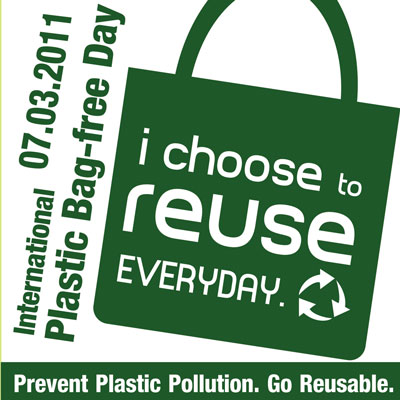
Join the 3rd of July International bag-free day!
 Can you imagine a Zero Waste world in which we continue to use single-use plastic bags? It is just not possible, right? There are several reasons why we should phase out single-use plastic bags in Europe.
On July 3rd it will take place the third international Plastic Bag-Free Day organised by GAIA and the Fundació Prevenció de Residus i Consum.
What can you do?
If you are an association/organisation:
* Organise a “Take the bag out of your head” action and let us know here. We will be compiling the actions taking place all over the world and collect pictures, stories, etc to share with all and we will coordinate a global press release.
* Spread the 3 July Statement, International Day Free Bags
* Refuse to take disposable bags and promote the use of reusable bags: Everyday but especially on July the 3rd!
* Upload the logo of the campaign to your website/blog. See Section Artwork
* Joint press release of July 3 (soon to be published in the Press section).
* Promote the action in your facebook page.
* Organize a workshop for your associates promoting the cloth bag.
* Organise a workshop with children on the topic. Promote it in schools.
 If you are a local/regional/national authority
* Make public statement on 3 July Statement
* Approve an ordinance to ban/reduce the use disposable bags
* Upload the logo of the campaign to your website/blog. See Section Artwork
* Tell media to cover events. Promote the action in your facebook page/blog.
* Take a picture of someone important in the institutions taking the plastic bag out of his/her head and use it as a promotion tool.
* Distribute reusable bags to shops and a flyer proposing alternatives to the use of single-use plastic bags.
* Joint press release of July 3.
* Organise a workshop with children on the topic. Promote it in schools.
If you are an individual
*Give your support to the action by signing up this statement. We will be gathering global support in favour of phasing-out plastic bags.
* Get together with your organisation, friends, family, neighbours, etc and organise a “Take the bag out of your head” action. If you do so please let us know here. We will be compiling the actions taking place all over the world and collect pictures, stories, etc to share with all and we will coordinate a global press release.
You can find graphic resources and ideas for your actions here.
You can join the facebook campaign here.
When?
The actions will take place on Sunday, 3rd of July. Please let us know beforehand if you are planning to organise an action.
Why?
There are many reasons! Here you have some:
http://www.zerowasteeurope.eu/phasing-out-single-use-plastic-bags/
http://noplasticbags.blogspot.com/
http://culturechange.org/e-letter-plastics.html
http://www.envirosax.com/plastic_bag_facts
Please join this global action and promote it among your friends. Together we can get rid of single-use plastic bags and get closer to Zero Waste!
Senin, 13 Juni 2011
Door-to-door Separate Collection Guide
 Want to implement a Zero Waste separate collection strategy in your municipality and don't know how? The "Manual de Recogida Selectiva Puerta a Puerta" is what you need.
The Catalan Association of Door-to-Door Municipalities has published a new version of the Manual of door-to-door separate collection in which the experts in door-to-door separate collection in Catalonia explain how implementing a door-to-door separate collection system:
- can increase the separate collection from 30-40 (road-container collection) to 70-80% (with door-to-door),
- can increase the quality of the recovered materials,
- can reduce the disposal costs by considerably reducing the residual fraction of the waste.
In the book there are practical examples of how a door-to-door separate collection should not cost more than a normal comingled collection yet provide a lot higher material recovery rate.
The book focuses in the reality in Spain and it is written in Spanish but for those who can read Spanish or Catalan (the original version was in Catalan) this is worth a read.
You can download it free of charge here or just by clicking on the picture.
Langganan:
Postingan (Atom)