Selasa, 31 Mei 2011

Are Nespresso-type coffee capsules compatible with Zero Waste?

The coffee capsules from Nespresso, Lavazza and others have taken over the coffee market in the EU. Normally they are made of fully recyclable materials (alluminium or plastic + coffee grounds) but they are very rarely recycled. Why?

Is it bad design? is it bad take-back systems? Whatever it is the fact is that since the commercialisation of these items a lot more resources go to waste. This means more burden for the environment and more costs for citizens who have to shoulder costs which should be beared by those who introduced this product in the market.

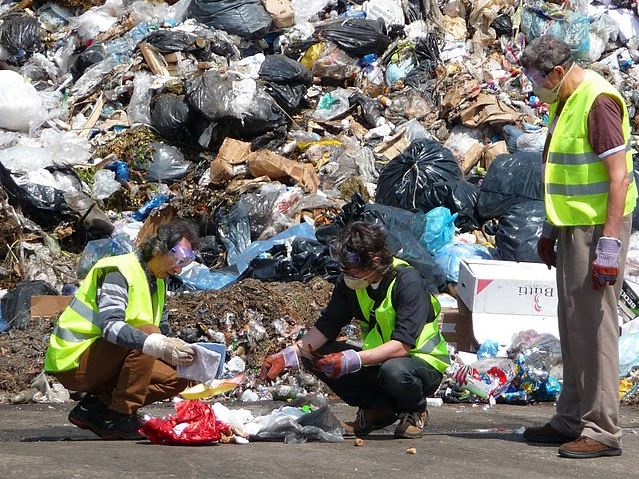
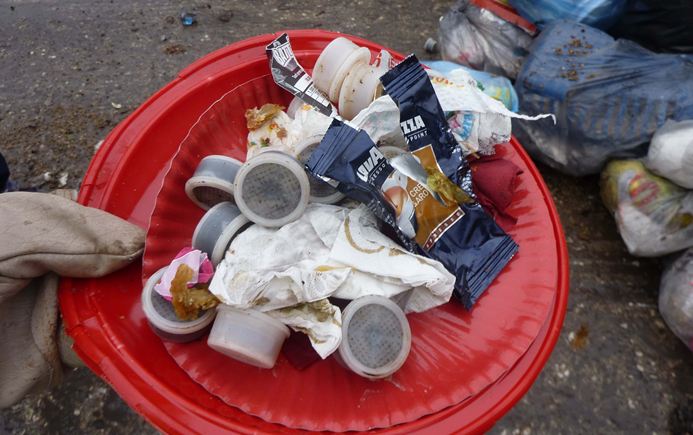
The Cappannori Zero Waste Research Center identified the coffee capsules as the first item to remove from the residual waste after high separate collection has been reached. Indeed, coffee capsules is a new waste stream that was just non-existant only 5 years ago. Now it is yet another source of waste that could be avoided. In 2010 it was estimated that 10 billions of capsules where sold in the world, a tenth of them in coffee-loving Italy. Only in Italy 12.000 tones of capsules (plastic/aluminium + coffee grounds) were disposed of in landfills and incinerators.
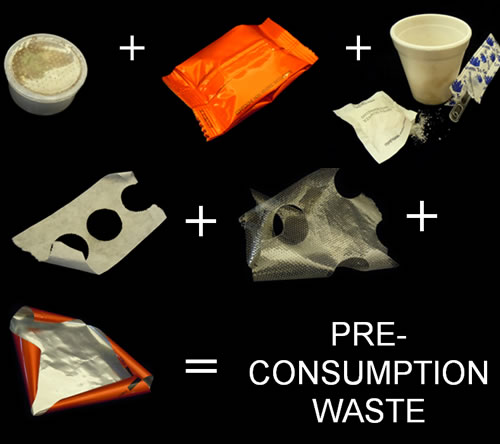
The Zero Waste Research Center documented the evidence and sent a letter to Lavazza and Nespresso in which they asked for a meeting to discuss the issue. The companies’ reaction was quick and a meeting was set up not only with the presence of Capannori Zero Waste Research Center staff but also with the italian food industry. In this meeting Nespresso and Lavazza committed to find solutions to this problem.

The companies rightly claim that their products are recyclable (the capsule) and compostable (the coffee grounds), but the problem is that for that to happen the capsules need to be collected and the recyclables sepately treated. The companies have no incentive to do this and the authorities fail to make the producer pay for the waste they put in the market.

Nespresso for instance has a goal of reacing 75% recycling of its capsules for 2013 in the EU but with the current take-back systems and lack of incentives it is unlikely that recycling will go beyond 25%. A good way to make sure that coffee capsules would go back to the producer would be to set a deposit system that would encourage the consumer to get involved in the process. This would be good for the environment, for the consumers and for the local authorities... in the long run it would also be good for the coffee companies who would get back the raw materials but in the short term it is clear that the Nespressos and Lavazzas of this world prefer passing the costs to the consumers and the environment. However, these costs could be internalised only with a fraction of the budget they dedicate to marketing. Only political will is lacking to make polluter pay.

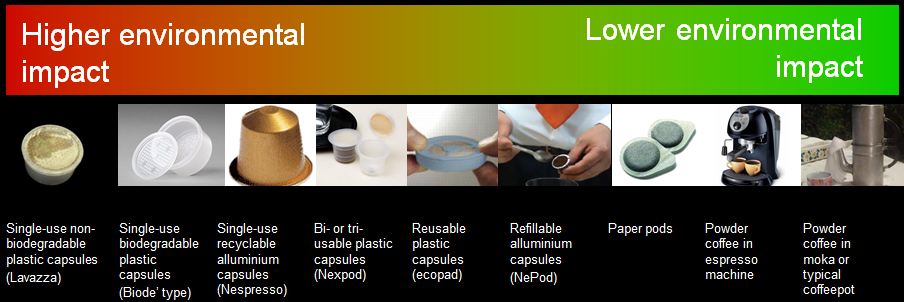
In a Zero Waste world there is no place for disposable coffee-capsules. If capsules are to stay it should be under the condition that the companies set up take-back systems that allow them to recover the coffee grounds to make good compost and the capsule to be reused –when possible- or recycled (not 75% but close to 100% like in deposit systems for beverages). In the meantime there is no better option than taking your coffee in the bar.
READ MORE - Are Nespresso-type coffee capsules compatible with Zero Waste?

Kamis, 19 Mei 2011

If You Care about Zero Waste...

Common kitchen and household products such as aluminium foil, baking paper, coffe filters or sandwich bags are the visible side of how sustainable and toxic-free our everyday life is.

A Zero Waste approach to these kind of products is based on prevention: if products are toxic-free and biodegradable they will not become waste but compost, if products are made from recycled materials they will save many materials & emissions, etc...

“If You Care” is a swedish brand of environmentally friendly kitchen and household products. Starting in 1990 “If You Care” launched unbleached coffee filters. Parchment Baking Paper and Baking Cups soon followed. All of the paper products were unbleached and totally chlorine-free -since no chlorine is used for bleaching, no chlorine is dumped into our lakes, rivers and streams-. In 2004, the very first Aluminum Foil made from 100% recycled aluminum was launched. This product featured a 95% energy savings compared to conventional aluminum foil. Heavy Duty Aluminum Foil for grilling and barbecuing, also from 100% recycled aluminum, was introduced in 2007. That same year, waxed paper, from unbleached paper coated with soybean wax was launched. In 2009, two new products were launched – 100% carbon neutral fire starters, made from FSC certified wood and vegetable oil, and sandwich and snack bags made from unbleached greaseproof paper. Many new products in a wide variety of categories are being planned and developed in the coming years.

“If You Care” kitchen and household products are carefully and deliberately crafted to have the least environmental impact and the lightest carbon footprint possible, while at the same time, delivering to the consumer, the highest quality and most effective results.

Following the Zero Waste philosophy “If You Care” products are produced with a view to reducing the amount of waste in our waste streams. The packaging of every product is made from unbleached and whenever possible, recycled cardboard or paper which should be recycled again. The coffee filters, parchment paper, baking cups, waxed paper and sandwich bags are 100% biodegradable and should be composted. The aluminum foil is made from recycled aluminum and can be recycled again.

“If You Care” is yet another example of how business and Zero Waste go hand in hand. Less toxics in the environment and less waste to be disposed of means less harm and expenditure for the communities.
READ MORE - If You Care about Zero Waste...

Selasa, 17 Mei 2011

Wasara, Seletti... and other ZW companies

http://www.wasara.jp

As the fate of all paper tableware, it can only serve its purpose only once. Yet, it is designed to minimise waste. Wasara uses reed, bamboo, and bagasse (sugarcane waste) pulp as a material. By replacing wood pulp with non-wood materials we use materials more efficiently. At the end of use paper tableware can return to the soil so that new life can spring.
READ MORE - Wasara, Seletti... and other ZW companies

Kamis, 12 Mei 2011

The first European Zero Waste Research Center - Capannori, Italy

The first Zero Waste Research Center in Europe was founded in Capannori, Italy, in December 2010. The research center is a vital piece of a Zero Waste strategy because it is impossible to slim the waste bin if we don’t know what ends up thrown in it. In order to get to Zero Waste, waste needs to be made very visible so that we can develop actions to prevent waste from ending up there.

The traditional systems of waste management are designed to hide waste. The claim that landfills and incinerators make waste disappear it’s nothing else but a myth. As Professor Paul Connett says: landfills bury the evidence and incinerators burn it (i.e. bury them in the atmosphere and in toxic ashes). If we want to act against waste, we have to make it very visible.

This is why the Zero Waste Research Center was created; to study what is left in the residual fraction of the household and commercial waste. Capannori, like many other italian municipalities where the door-to-door collection systems are applied is above 75% separate collection. Therefore it is time to look into what is left in the remaining 25% in order to advance towards Zero Waste.

The first step is to do a caracterisation of the residual waste; i.e. analyse samples of residual waste to know its configuration. See the next table to know what was found in the residuals:

As we can see 85% of what is found in the residual fraction can be prevented, composted or recycled. 28% of it are plastics, 22% is biodegradable, 16% is clothing and 13% nappies. This means that if the right policies are in place the total household and commercial waste that should be sent to disposal would be less than 5% of the total waste generated!

The ZW Research Center is composed of an operative team with industrial designers charged with the task of proposing changes to the design of badly designed products. These proposals are then sent to the producers responsible for the manufacture of toxic and/or non-recyclable and/or non-biodegradable in order to give them sustainable alternatives.

The Center also has an Scientific Committee composed of waste experts, university professors and other technical people who can provide useful advice.

Albeit its very limited resources the Zero Waste Research Center is setting an example to follow for any municipality who wants to advance towards Zero Waste.
READ MORE - The first European Zero Waste Research Center - Capannori, Italy

Senin, 25 April 2011

Compostadores.com example of Zero Waste company

Composting -specially home-composting- is one of the best waste prevention and recycling activities. The Barcelona based company compostadores.com has managed to create a Zero Waste business making composting even more sustainable: by using recycled materials to build the composters.
One of the main principles of a zero waste company is that raw materials should be obtained from recycled materials and not from new extraction and compostadores.com has built its business model on this premise.

The combox are made entirely from recycled and recyclable plastics from post-consumer waste. The result is a 100% recycled, recycling and recyclable product.

An average European citizen generates around 1,5kg of waste per day and 40% of it is organics. Composting we can reduce the weight and volume of the organic waste by 70%. This means that if in Europe biowaste would be separately collected and composted the amount of waste to be sent to landfill and incineration could be considerably reduced. Unfortunately, the European Union continues to oppose these biowaste recycling targets but nothing stops any responsible EU citizen to start doing home-composting.

Compostadores.com offers the tools to get soil improver for free, reduce the waste generation and help fight climate change.

READ MORE - Compostadores.com example of Zero Waste company

Selasa, 19 April 2011

Zero Waste growing in the UK

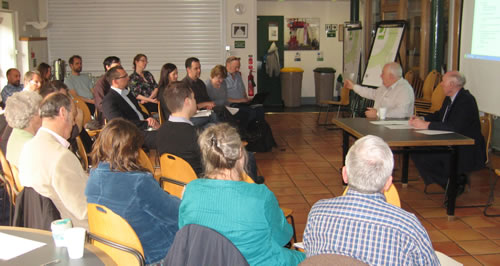
Last Saturday 17th of April 2011 took place in London the annual meeting of the Zero Waste Alliance UK with participants coming from Scotland, Wales and England.

Among the participants there were activists, academics, professional recyclers, social enterpreneurs, politicians and average citizens interested in the topic and it showed the growing interest for the Zero Waste philosophy in the country.

The meeting served to strategise about future plans of the Zero Waste Alliance UK and it also elected a new board and directors.

Among other speakers there was the Zero Waste pioneer, Robin Murray, an industrial economist author of the book “Creating Wealth from Waste” published in 1999 and reference for the Zero Waste philosophy. All in all it was a very stimulating event that laid the ground for a year of expansion of Zero Waste in the country.

Excerpt from Chapter 14 of the book “Creating Wealth from Waste” from Robin Murray:

A programme for zero waste

1. The economic playing field must be rebalanced. The hierarchy of profitability must match the environmental hierarchy. This can be done by revising waste taxes and public benefits in three ways: o introducing a disposal tax that reflects the environmental hierarchy o cutting the subsidies presently given to incineration o introducing a price guarantee scheme for recycled materials to fund the build-up costs of four stream recycling.

2. The £550 million raised in waste taxes must be re-channelled to a Zero Waste Fund. This requires: o a change in the landfill tax regulations so that the 20 per cent offsets are paid into the publicly-run recycling fund o earmarking a further 20 per cent to support employment and environmental goals through recycling o amending the packaging recovery regulations so that payments by the 'obligated parties' are channelled to recycling collectors.

3. Establishing a Zero Waste Agency to administer the transitional funds and 'animate' the change.

4. Founding a new type of Green Academy, equivalent to the German technical schools of the mid-nineteenth century. It would be charged with developing organisational forms, knowledge and skills relevant to zero waste, and new ways of generating 'distributed intelligence'. Its curricula and priorities would be set by the needs thrown up by the new environmental systems. Hence its research, teaching and skill formation would be linked closely to ground level projects - following the approach of the Ulm School of Design - and provide learning resources to those in or outside employment.

5. Appointing Zero Waste Advisers - some recruited from leading recycling and reduction projects overseas - to advise on recycling schemes and projects. The group would be part of an international network, promoting exchanges and part-time attachments, and linking into practitioners' associations.

6. The launch of a 'Closed Loop Industrialisation' Initiative, promoting the development of secondary materials industries, ecodesign and hazard reduction technologies. In addition to material productivity, it would aim to promote 'de-scaling' technologies suitable for local and regional economies. It would be organised in conjunction with regional development agencies.

7. The extension of producer responsibility into new fields, not only electrical and electronics appliances, end-of-life vehicles and tyres, but other durable equipment, newspapers, and hazardous products and materials. The weight of responsibility should be placed at the point of product and process design, since they have the greatest capacity to develop alternatives. In each case, the finance contributed by producers should be re-channelled to develop the alternatives.

8. Devolving responsibility for waste disposal to districts, through direct payments for the costs of disposal (rather than property-based precepts) and giving districts responsibility for identifying and negotiating disposal options within their own boundaries or with neighbouring districts. This would represent the proximity principle with teeth.

9. Restoring public confidence in wade management and democratising risk through: planning reform to give financial support and access to information to civil groups and neighbourhoods affected by waste proposals; a new culture of openness in regulatory bodies; an independent waste hazards control advisory body; and an environmental freedom of information provision.

10. A govemment-led commitment to the zero waste target 'within a generation', reflected in the above measures and the adoption of tighter targets to 'reduce with the aim of eliminating' mixed waste disposal by 2010. This would include a phased ban on organic waste in landfills and on landfilling or incinerating hazard-producing materials, and a moratorium of new mixed waste incinerators for five years.
READ MORE - Zero Waste growing in the UK

Selasa, 05 April 2011

Zero Zabor - new Zero Waste groups in the Basque Country


New Zero Waste groups are appearing in the Basque Country. Following the experience of Usurbil, a municipality that has achieved 88% separate collection after only two years of implementation of the door-to-door collection, and after the municipalities of Hernani and Oiartzun have joined this system of separate collection, 7 new groups of citizen-led Zero Zabor (Zero Waste) groups have appeared in the region of Guipuzkoa in the spanish Basque Country.

Usurbil was pioneer in challenging the separate collection by means of road container (which was achieving rates always below 40%) and decided to implement door-to-door system. Hernani (20.000hab) and Oiartzun followed this example a year later and currently the three of them are all above 75% of separate collection.

However the region of Guipuzkoa still insists in building an incinerator and, in view of the success of the Zero Zabor experiences, has speeded-up the works to stop other municipalities from joining the Zero Waste model. Moreover the Guipuzkoa region refuses to increase the current composting capacity of only 2.500tn and the 4.400tn of high quality organic waste that is separately collected can’t be composted –as the European waste hierarchy would request-.

But the Zero Waste philosophy counts with the support not only of some engaged municipalities but also of citizen groups that are tirelessly working to spread the word that reducing waste and increasing recycling is not only necessary but also possible. By replicating the experienced pioneered by Usurbil and followed by Hernani, Oiartzun and others, Guipuzkoa could create more jobs, less pollution and more local economy and save the 400 million euros that the new unnecessary incinerator will cost. In Guipuzkoa a struggle between the past and the future is taking place, between those who want to burn waste and those who want to reuse and recycle resources. The Zero Waste strategy is showing the alternative to end-of-pipe obsolete technologies and with the new groups in the Basque Country and the already existing Catalan Zero Waste network the change is advancing in Spain.

Websites of the Zero Waste groups in Euskadi -Spanish Basque Country-:
http://www.gipuzkoazz.com/zerozabor
http://zerozabor.ning.com/
http://zarautz0zabor.wordpress.com/
http://zerozaborzumaian.wordpress.com/
http://usurbilzz.wordpress.com/
http://www.blogak.com/gipuzkoasinincineradora/
READ MORE - Zero Zabor - new Zero Waste groups in the Basque Country